More About This Card
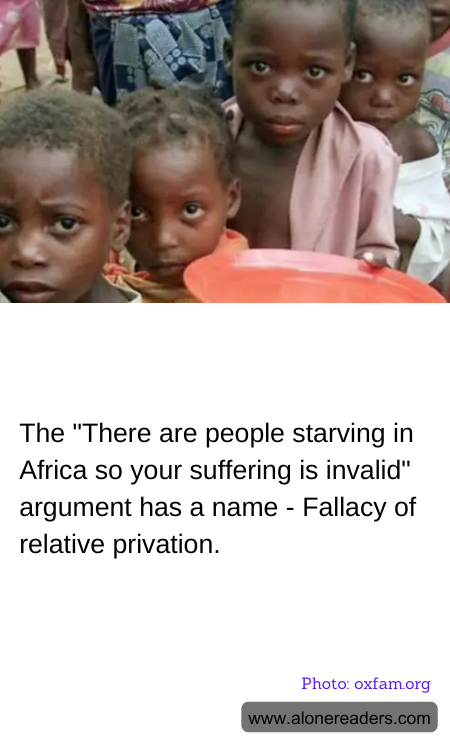
The Fallacy of Relative Privation, often colloquially summarized by phrases like "There are people starving in Africa so your suffering is invalid," is a logical fallacy which attempts to dismiss an individual's concerns or problems by comparing them to those of others deemed worse off. Essentially, it's arguing that experiencing lesser suffering or difficulty renders one's position or experience less significant or unworthy of sympathy and attention.
This fallacy can be both dismissive and damaging, as it undermines the validity of a person's feelings and personal experiences. Psychological and emotional pain is subjective; different individuals experience and process circumstances in vastly different ways, depending on a myriad of factors such as personal history, resilience, support systems, and mental health states. The fallacy trivializes these individual experiences by suggesting a hierarchical approach to suffering, where only the most severe examples warrant attention and care.
Moreover, employing the fallacy of relative privation in discussions about socio-economic issues or personal challenges can obstruct constructive dialogue and inhibit empathy. It diverts the focus from addressing the issue at hand to measuring it against an external and often unrelated context. Instead of fostering understanding or progress, it may lead to feelings of guilt, inadequacy, or suppressed emotions in individuals whose problems are deemed "lesser."
It's important in both personal and public discourse to recognize that acknowledging one person’s difficulties does not necessitate denying the severity of another's. Compassion and support are not finite resources that must be rationed according to the perceived severity of different situations; rather, they are tools through which societal bonds are strengthened and individual resilience can be built. Everyone's experiences are valid and deserve recognition, and addressing smaller hardships does not preclude the acknowledgment or alleviation of more severe crises elsewhere.
Encouraging a more inclusive understanding of suffering helps to promote a more empathetic and supportive community where individuals feel valued and understood, rather than judged against a global scale of hardship. This approach not only validates individual experiences but also encourages a healthier, more cooperative society.