More About This Card
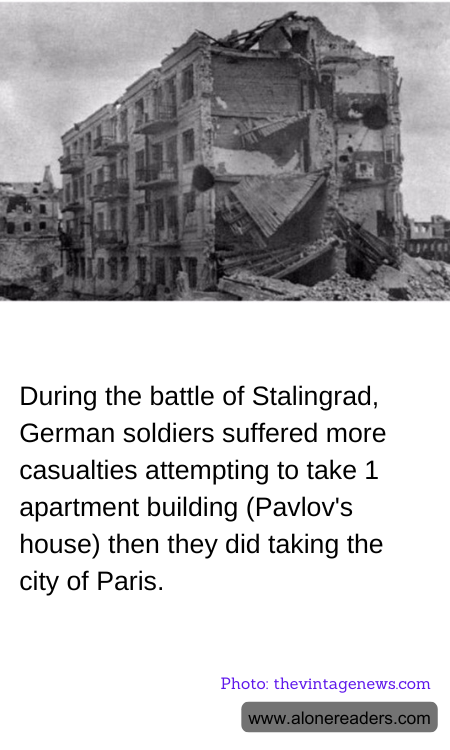
The Battle of Stalingrad, one of the deadliest and most pivotal confrontations of World War II, is often remembered for its brutal urban warfare and the extraordinary resilience displayed by the Soviet defenders. One striking symbol of this fierce resistance is Pavlov's House, a nondescript apartment building that became the scene of one of the war's most intense skirmishes. Remarkably, the German army incurred more casualties trying to capture this single structure than they had in their entire campaign to take Paris, highlighting the sheer ferocity and strategic significance of the battle for Stalingrad.
Pavlov's House was defended by a platoon led by Sergeant Yakov Pavlov. The building's location was strategically important because it overlooked a wide area around the Volga River, making it a critical point of defense against the advancing German troops. Pavlov's platoon fortified the building, creating a stronghold that withstood constant assaults from German forces. The resistance offered by the Soviet soldiers at Pavlov's House was emblematic of the Soviet resolve to defend Stalingrad at all costs.
The defense of Pavlov’s House lasted for about two months, from September to November 1942. During this time, it is estimated that the Germans lost more men trying to capture this building than they did during the swift takeover of Paris in June 1940. The stark contrast in casualties underscores the tactical differences between the two battles; whereas the Fall of Paris was marked by rapid maneuvering and relatively light fighting, Stalingrad witnessed prolonged and intense urban combat, which dramatically increased the number of casualties.
The heavy losses suffered by the Germans in their attempts to take Pavlov’s House were due not only to the strategic use of the building by Soviet forces but also to the psychological boost it gave the defenders. It became a symbol of Soviet endurance and invincibility, inspiring other units citywide even as the situation appeared increasingly bleak. This morale effect, coupled with the tactical advantage of holding a fortified position, contributed significantly to why such a high price was paid by the Germans for attempting to overrun that position.
In the grand narrative of World War II, the story of Pavlov's House is a testament to how pivotal individual buildings, and the soldiers who defended them, could become in the broader strategy and outcome of the war. This incident not only highlights the ferocity of the Battle of Stalingrad but also adds a human dimension to the immense sacrifices made during the conflict. Such fierce resistance ultimately contributed to the failure of the German offensive on the Eastern Front, marking the beginning of a significant shift in the war's momentum.