More About This Card
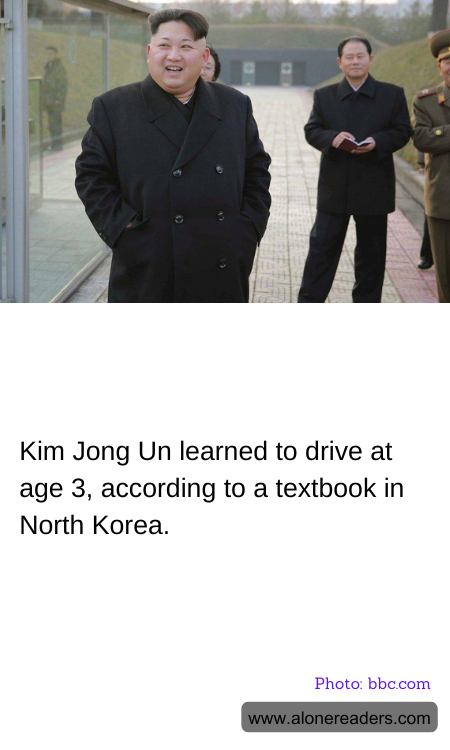
In a compelling reflection of the intense personality cult surrounding North Korea's leadership, it is claimed in a North Korean textbook that the nation's leader, Kim Jong Un, learned to drive at the remarkably young age of three. This assertion is a vivid example of the mythologizing of leaders in the secretive state, mirroring stories historically promoted about his father, Kim Jong Il, and grandfather, Kim Il Sung, which serve to elevate their statuses to almost mythical proportions.
The anecdote about Kim Jong Un’s early driving skills is not an isolated case; rather, it is part of a broader narrative strategy used by the North Korean regime to idolize their leaders and depict them as prodigious, superhuman figures. These narratives are typically disseminated through state-controlled education systems and media to ensure a uniform public perception that aligns with the state's propaganda goals. For instance, Kim Jong Il was famously reputed to have had the ability to change the weather with his mood and to have scored an impossibly perfect game the first time he went bowling.
For observers outside North Korea, these stories often seem implausible and serve as a stark reminder of the regime’s extensive propaganda apparatus and its potential impacts on the North Korean population. Such tales are instrumental in shaping a national identity that is intrinsically linked to a deified leadership, often obscuring the harsh realities and challenges faced by the populace under the regime’s rule.
These narratives, while striking, also pose significant challenges for international relations and diplomacy. The demigod status of North Korean leaders makes normal diplomatic interactions difficult, as the regime’s legitimacy is built on unchallengeable reverence for its leaders rather than on governance structures or political ideologies. This form of leadership cult complicates the engagement strategies of other nations and international bodies, often leading to a policy approach that oscillates between cautious engagement and strategic containment.
Understanding these myths not only gives insight into the unique political and cultural landscape of North Korea but also highlights the power of narrative in authoritarian regimes. It underscores the importance of critically assessing information and encourages a nuanced view of how leadership is constructed and maintained in different political contexts.