More About This Card
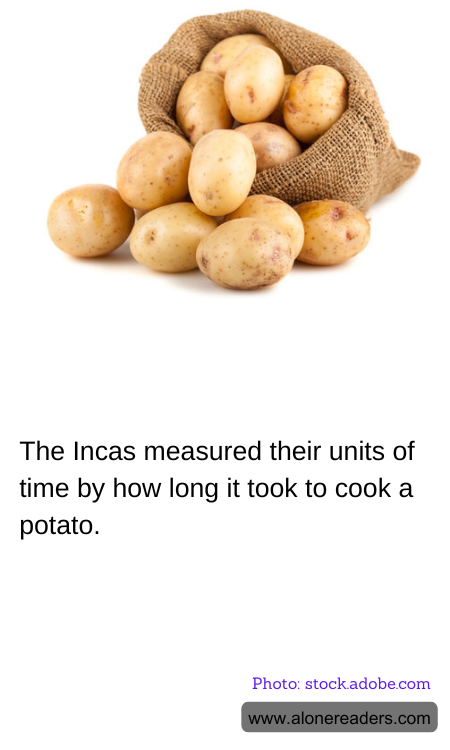
While it might sound like a quaint anecdote, the claim that the Incas measured time based on how long it took to cook a potato is not supported by historical evidence. The Inca civilization, which flourished in the Andean regions of South America before the Spanish conquest in the 16th century, had a sophisticated understanding of time and astronomy, primarily driven by agricultural needs and religious observances rather than culinary timers.
The Incas did not have written records, but they used a complex system involving quipus—a set of colored strings with knots that served numerical and possibly narrative functions—to record information. They carefully observed astronomical events, such as the solstices and equinoxes, which played crucial roles in their calendar and agricultural activities. Their year was divided into twelve lunar months, each with its own festivals, rituals, and agricultural tasks. Additionally, the Incas used sundials, such as the Intihuatana stone at Machu Picchu, which has been interpreted as an astronomic clock or calendar.
The potato, a staple of Andean agriculture domesticated by the Incas, indeed held significant value in their society. However, its role was primarily nutritional and agricultural rather than temporal. The cooking of a potato is far too variable a measure, affected by factors such as the size of the potato, the intensity of the heat, and altitude, to serve as a practical unit of time for a civilization.
The myth of the Incas using the cooking time of a potato as a time measurement unit seems to be a modern invention or a misunderstanding of the complex and efficient systems the Incas developed to manage their empire which spanned large portions of modern-day Peru, Ecuador, Bolivia, and Chile. Instead, their achievements in civil and hydraulic engineering, agriculture, and architecture testify to their practical and precise understanding of both time and the natural world. Such misconceptions, though intriguing, diminish the sophistication of Inca technology and the ingenuity of their cultural practices, which have been subjects of admiration and study for historians and archaeologists alike.