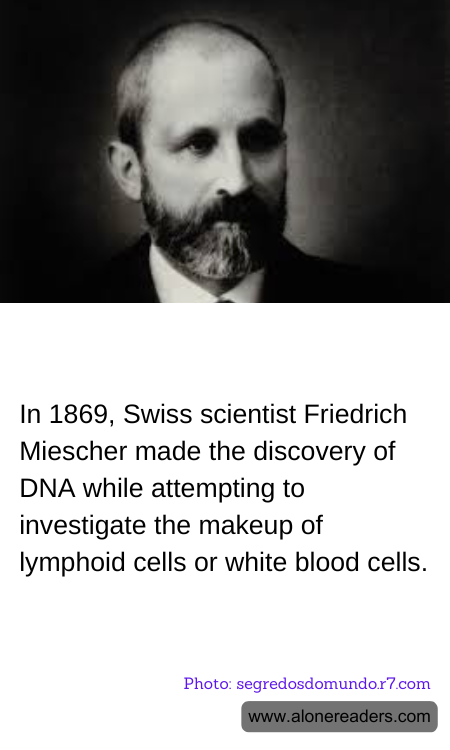
More About This Card
In 1869, Friedrich Miescher, a Swiss scientist, embarked on research that would eventually lead to one of the most significant scientific discoveries. While examining the composition of lymphoid cells, or white blood cells, he isolated a new substance from the nuclei of the cells, which he named "nuclein." This substance, which we now know as DNA, initially puzzled Miescher although he recognized its significance. He observed that nuclein contained phosphorus and nitrogen, but its functions remained unclear.
His discovery went largely unappreciated during his own time, as the scientific community of the late 19th century did not yet understand the role of DNA in heredity. It wasn't until the mid-20th century that researchers like James Watson and Francis Crick uncovered the double helix structure of DNA, solidifying its central role in genetics. They, along with Maurice Wilkins and Rosalind Franklin, showed how DNA’s structure enables it to copy itself and encode the information necessary for the structure, function, and regulation of living organisms.
Miescher's work laid the foundational stone for molecular biology, influencing further scientific inquiry and crucial developments in genetic research. His discovery of DNA from the pus-coated surgical bandages, no less, underscores a theme in scientific exploration: significant breakthroughs often occur unexpectedly, under unusual circumstances, and while searching for answers to completely different questions. Miescher's perseverance and curiosity not only opened up a new avenue in cellular biology but also eventually revolutionized medicine, forensic science, and our understanding of life itself.