More About This Card
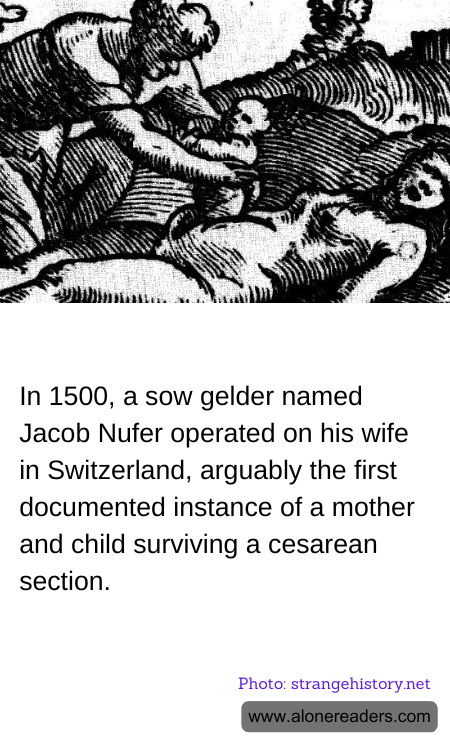
The history of cesarean section dates back to antiquity, but tangible survival rates for both mother and child from such procedures are relatively modern achievements. The story of Jacob Nufer, a sow gelder from Switzerland, offers a fascinating glimpse into the early practice of this surgical procedure. In 1500, after several days of labor and unsuccessful assistance by midwives, Nufer performed the operation on his wife when no other physician was willing or able to do so. It is reported that with the aid of a crude set of surgical tools, Nufer successfully extracted his living child from the womb of his wife, who astonishingly, also survived the surgery.
This event is particularly noteworthy not only because it is one of the earliest documented cesarean sections where both mother and child survived but also because it contrasts sharply with the common outcomes of the time, which typically saw such surgeries performed only when the mother was dead or dying. Nufer's successful operation challenged the norms and opened a discourse on the potential of surgical intervention for saving lives in obstructed labor cases.
This instance also highlighted the improvisational skills that non-professional practitioners like Nufer, who had experience mainly in animal surgery, could bring to human medicine under desperate circumstances. It underscores how medical emergencies can drive individuals to extraordinary measures, leading to outcomes that can shift medical paradigms.
However, it is essential to note that while the case of Jacob Nufer is celebrated, it also marks a period when the practice of cesarean sections was fraught with risks such as infection and limited by the lack of effective anesthetics and antiseptics. The survival of Nufer's wife and child is an exception in the historical context and had it not been for advancements like the introduction of sterile techniques and antibiotics, cesarean sections might have remained extraordinarily dangerous.
Today, cesarean sections are common and generally safe due to medical advances, but the tale of Jacob Nufer remains a powerful reminder of the ingenuity and desperation that have driven medical innovation throughout history. His story exemplifies how necessity has often been the mother of invention in the field of medical science.