More About This Card
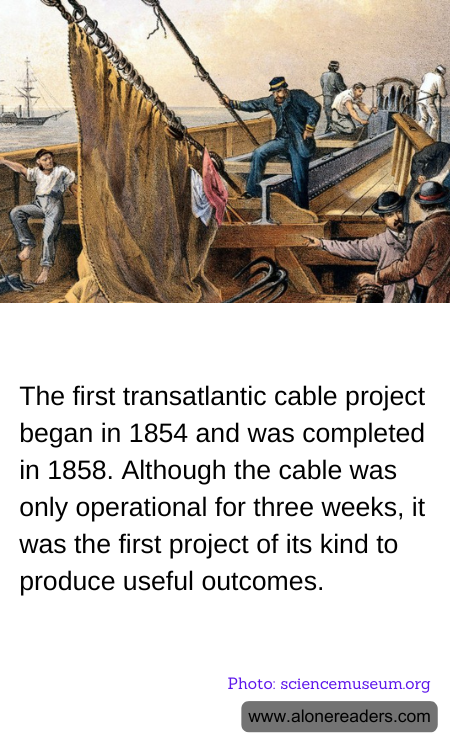
The first transatlantic cable project marked a monumental step in global communication, embodying the height of Victorian engineering and ambition. This pioneering project began in 1854, a time when messages between Europe and North America had to be carried by ships, a journey that typically took at least ten days. The vision was revolutionary: to create an instant communication link under the Atlantic Ocean.
The project was spearheaded by Cyrus West Field, an American businessman who believed in the possibility of connecting the continents via a telegraph cable. Despite numerous challenges, including technical difficulties, deep oceanic terrain, and financial constraints, the persistence of Field and his team culminated in 1858 when the cable was finally laid between Valentia Island in Ireland and Heart's Content in Newfoundland, Canada.
The cable itself was an engineering marvel made from seven copper wires encased in gutta-percha (a form of natural rubber), tarred hemp, and armored with iron wires. It spanned a whopping 2,500 miles across the ocean floor. Its completion was met with great fanfare on both sides of the Atlantic; it was even celebrated with a 100-gun salute in New York City.
Communications initiated on August 16, 1858, with the exchange of congratulatory messages between Queen Victoria and President James Buchanan, heralding a new era in transatlantic relations. Despite its success, the cable's operational life was short-lived; it ceased functioning just three weeks after it was opened. The primary cause of its failure was attributed to the use of excessive voltage by the chief electrician, Wildman Whitehouse, which damaged the cable's core.
Although operational for only a brief period, the 1858 transatlantic cable project was far from a failure. It demonstrated the feasibility of long-distance undersea communication and paved the way for future ventures. Lessons learned from this initial attempt were crucial in laying subsequent cables with more durable designs and more sophisticated electrical technology. Just eight years later, in 1866, a new, more robust cable was successfully laid, providing reliable and continuous service.
This trailblazing project significantly reduced the time it took to communicate across the Atlantic, from weeks to mere minutes, thereby shrinking the world in a way that was previously unimaginable. It was the first of many technological steps towards the modern, hyper-connected world we live in today.