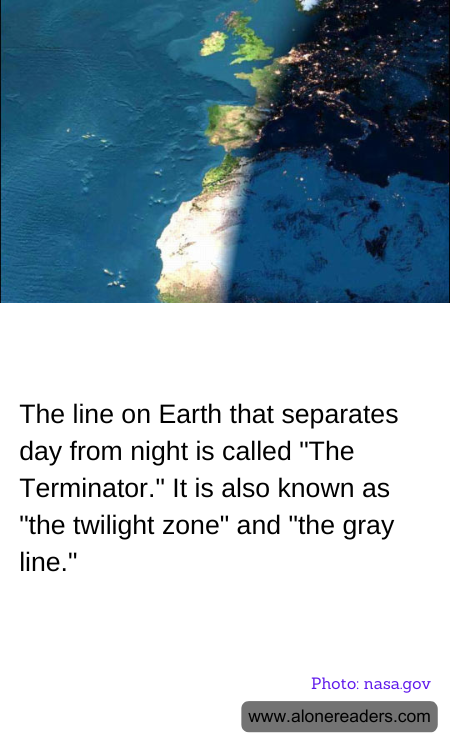
The Terminator is one of Earth's most fascinating geographical phenomena, demarcating the moving line that separates the daylight side of the planet from the night side. This line is also poetically referred to as "the twilight zone" or "the gray line," highlighting its symbolic and literal representation of transitions. This boundary is not fixed but shifts continuously as the Earth rotates on its axis, creating and erasing shadows across the globe over a 24-hour cycle.
Geophysically, the terminator is a real-time illustration of the Earth’s rotation in relation to the sun. Its movement is dependent on the axial tilt and the orbital position of the Earth, which explains why the terminator's orientation changes with the seasons. During equinoxes, the terminator is aligned vertically, running directly from the North to South poles, creating almost equal day and night spans worldwide. Conversely, during solstices, the tilt of the Earth’s axis leads to a terminator that curves, giving rise to extended periods of daylight or darkness in the polar regions.
An interesting aspect of the terminator is its impact on local climates and weather patterns. The temperature gradient generated by this line, with one side under the warming rays of the sun and the other cooling rapidly in darkness, can cause specific atmospheric phenomena like morning fogs or dew. This temperature difference can also influence wind patterns and precipitations.
Aside from scientific interest, the terminator holds allure for communication technology enthusiasts, especially amateur radio operators. Known as the "gray line" in ham radio parlance, this zone is ideal for radio wave propagation due to lower ionospheric density and less atmospheric noise. This phenomenon allows radio signals to travel further, making distant radio contacts more achievable during dawn and dusk—the periods when the gray line is most pronounced on any given point of the Earth.
Observing the Earth from space, the terminator appears as a soft, hazy line due to the scattering of sunlight through the atmosphere—an ethereal boundary between the glowing day and the quiet, shadowed night. Its constant motion is a reminder of the perpetual dynamics of our planet, embodying both the literal and metaphorical passage from time to time and from one state of being to another.
