More About This Card
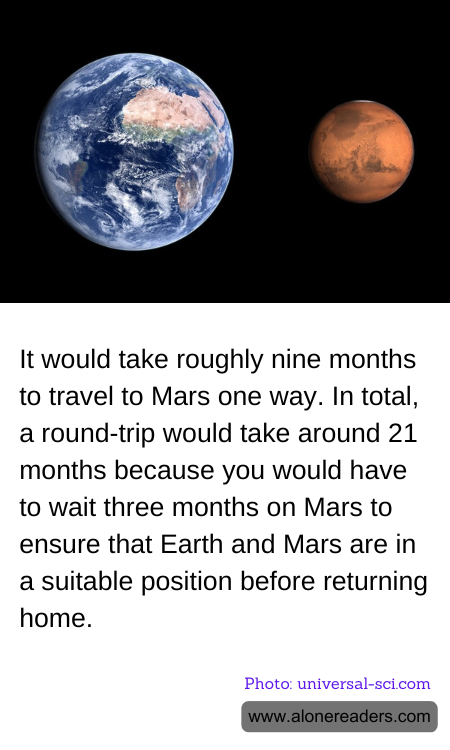
Traveling to Mars represents one of the most intriguing and complex challenges in the arena of space exploration. The journey itself is an arduous and prolonged engagement, primarily due to the vast distance that must be traversed. Indeed, the trip to Mars from Earth is no small feat, taking about nine months one way given current propulsion technologies and the orbital mechanics involved. This duration can vary slightly depending on the specific alignment of the planets at the time of launch, which occurs approximately every 26 months when Mars and Earth are favorably positioned.
Upon reaching Mars, astronauts wouldn’t simply turn around and come right back. Instead, they would need to wait for around three months on the Martian surface. This period is essential for a couple of reasons. First, it allows the astronauts to conduct scientific research, perform experiments, and possibly even prepare a site for future missions or long-term habitation. More critically, this wait ensures that the planets realign for a more energy-efficient return journey. Without this optimal alignment, the trip back to Earth could require significantly more fuel and time, potentially putting the crew and the mission at risk.
Therefore, considering the nine-month journey to Mars, a three-month operational period on the Martian surface, and another nine months to return, the total duration of a manned mission to Mars would be around 21 months. This extended time in space and on Mars poses numerous challenges, not only in terms of technology and resources but also in regards to the physical and psychological health of the crew. Issues like radiation exposure, bone density loss, and muscle atrophy must be mitigated. Moreover, the psychological effects of isolation and the confined living conditions are non-trivial and require effective countermeasures to ensure the wellbeing of the crew.
In conclusion, a manned mission to Mars is a monumental undertaking that involves careful timing and coordination, extended travel and habitation times, and comprehensive planning for health and resource management. The journey is not just a test of technological prowess but also of human endurance and adaptability. As technologies advance and more is understood about maintaining human health in space, the dynamics of such interplanetary travel may evolve, but the basic outline of the mission duration and requirements is set by our current understanding of space travel and planetary science.