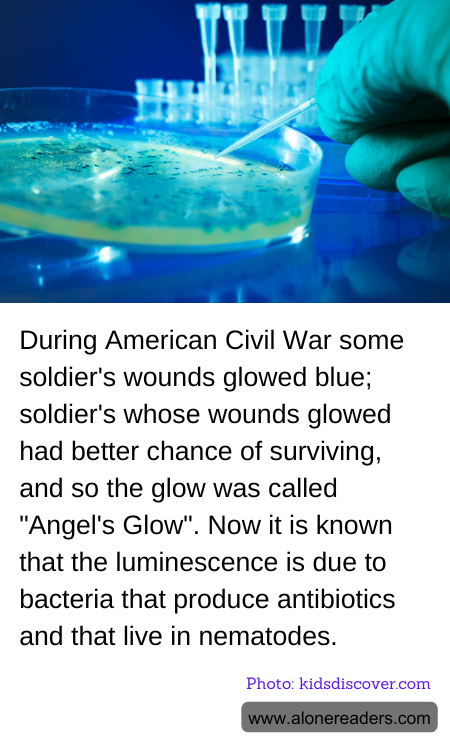
During the American Civil War, amidst the brutal and often unsanitary conditions of battlefield hospitals, a peculiar phenomenon was observed. Some soldiers who sustained injuries noticed that their wounds emitted a soft, mysterious blue glow in the dark. This unusual occurrence, which came to be known as "Angel’s Glow," seemed to offer a beacon of hope. Medical personnel and soldiers alike noted that those with glowing wounds were more likely to recover, compared to their counterparts who did not exhibit the same luminescence.
For many years, the cause of "Angel's Glow" remained a mystery wrapped in the folklore of war. It wasn't until over a century later that the true explanation came to light, combining elements of microbiology and parasitology. Researchers discovered that the phenomenon was the result of a symbiotic relationship between a type of parasitic nematode and bioluminescent bacteria, specifically from the genus Photorhabdus. The nematodes, which are microscopic worms, carry the Photorhabdus bacteria into their hosts. In the case of the Civil War soldiers, the nematodes were inadvertently introduced into their wounds.
Once inside a wound, the bacteria are expelled from the nematodes and begin to thrive in the moist environment, feeding off other, potentially harmful bacteria. The bioluminescent properties of Photorhabdus not only cause the eerie glow, but more importantly, they also produce natural antibiotics that combat infection from more dangerous pathogens. This antibacterial action likely reduced the rate of infections and consequently increased survival rates among the injured soldiers exhibiting "Angel’s Glow."
Understanding this phenomenon underscores the complexity of ecological relationships and the natural development of antibiotic agents. It serves as a poignant reminder of how phenomena that once seemed supernatural have scientific explanations waiting to be uncovered. The blue light that once gave hope amidst the gruesome realities of war now illuminates a fascinating intersection of biology, warfare, and medical science.
