More About This Card
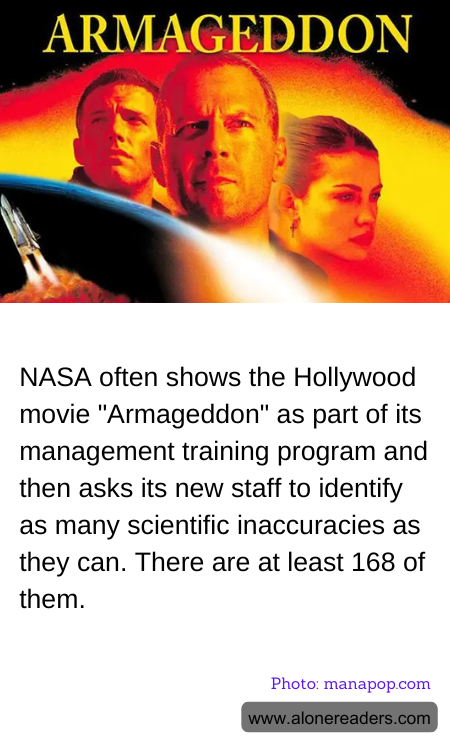
NASA's use of the movie "Armageddon" in its management training program is an intriguing approach to engage new staff in a critical analysis of science fiction versus science fact. The 1998 Hollywood blockbuster, known for its dramatic depiction of a team of oil drillers sent to space to destroy an asteroid heading for Earth, serves as an effective educational tool, despite—or perhaps because of—its numerous scientific inaccuracies. By challenging new staff to identify these errors, NASA encourages not only a deeper understanding of astrophysics and space technology but also sharpens analytical skills, which are crucial in the field of space exploration.
One of the most glaring inaccuracies in "Armageddon" is the portrayal of how space missions are conducted. For instance, the film suggests that NASA could train oil drillers to become astronauts within a few weeks, a process that in reality takes years of rigorous preparation. The movie also misrepresents the nature of an asteroid's surface, depicting it as a stable place to land and drill, whereas actual asteroids are often composed of a loose collection of rocks bound by weak gravitational forces.
Furthermore, the approach to dealing with the asteroid—drilling into its surface and planting a nuclear bomb—is overly simplified and technically questionable in the context of real-world astrophysics. In reality, the scientific consensus leans toward deflection, rather than destruction, as a strategy for dealing with potentially hazardous asteroids. Methods under study include gravity tractors or kinetic impactors, which are more about nudging the asteroid off its collision course with Earth rather than blowing it up.
By finding and discussing these inaccuracies, NASA's new recruits can gain a better grasp of the complexities involved in space missions and the importance of scientific integrity in communicating space-related topics. This exercise not only instills a critical mindset but also highlights the importance of public perception and the impact that Hollywood portrayals can have on it. Overall, this unconventional training method effectively brings to light the blend of entertainment and education while underscoring the critical thinking needed in the field of space exploration.