More About This Card
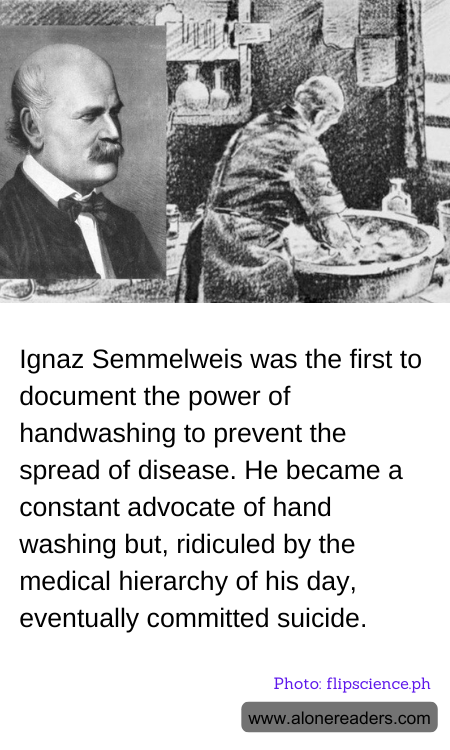
Ignaz Semmelweis, a Hungarian physician born in 1818, made a groundbreaking discovery in the mid-19th century that fundamentally transformed our understanding of disease prevention. Working at the Vienna General Hospital, he became deeply troubled by the high mortality rates from puerperal fever among women who had recently given birth in the hospital. Through meticulous observation and analysis, Semmelweis deduced that the cause of this high incidence of death was the transfer of infectious material from autopsies being performed by doctors who then went on to examine expectant mothers without washing their hands.
In 1847, Semmelweis implemented a policy requiring that all medical staff wash their hands with a solution of chlorinated lime before examining patients in the maternity ward. The results were striking and immediate: mortality rates plummeted. However, despite this success, Semmelweis's ideas were met with skepticism and resistance from the medical community. Many of his peers were offended by the implication that doctors could be responsible for spreading disease and were reluctant to adopt handwashing as a routine practice.
This resistance deeply impacted Semmelweis, both professionally and personally. His continued advocacy for handwashing was met with hostility, and he was eventually marginalized in the medical community. Distraught and isolated, his mental health declined, leading to his commitment to an asylum in 1865, where he died tragically just two weeks later, possibly from a beating by the guards.
Semmelweis's story is a poignant reminder of the challenges faced by pioneers in medicine and science, who often battle against established norms and beliefs to promote advances that we now take for granted. It wasn’t until years after his death that Semmelweis's practices gained widespread acceptance, spurred on by the work of scientists like Louis Pasteur and Joseph Lister, who provided the germ theory of disease and techniques of antiseptic surgery, respectively. Today, handwashing is universally recognized as one of the most simple, yet powerful, measures to prevent the spread of infectious diseases. Semmelweis's legacy lives on as a testament to the vital importance of empirical evidence in medical practice and the sometimes difficult path of advocating for systemic change in healthcare practices.