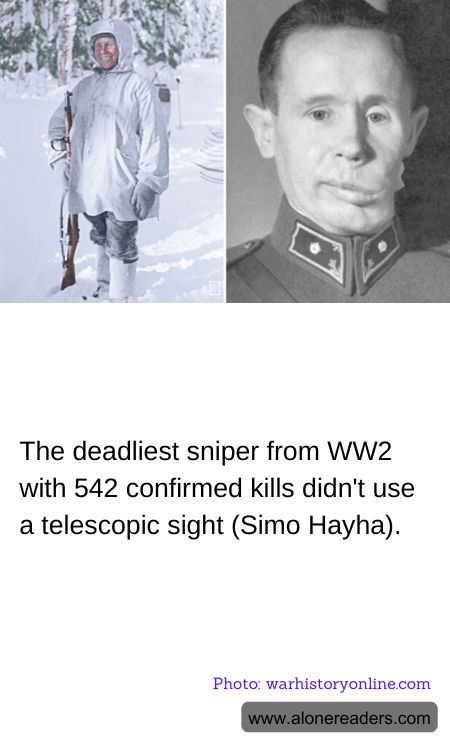
More About This Card
In the frost-covered forests of Finland during World War II, one figure emerged as a legendary marksman, feared and famed for his lethal precision. Simo Häyhä, known affectionately as "White Death" by his Finnish comrades and dreaded by his enemies, became the deadliest sniper in history, credited with 542 confirmed kills, all achieved without the aid of a telescopic sight.
Born in 1905 in the small Finnish province of Karelia, Häyhä grew up in a rural environment where hunting and shooting were a part of everyday life, skills that would later prove invaluable. Standing at just 5 feet 3 inches tall, his stature made him an unlikely warrior, but his proficiency with a rifle was unmatched. When the Winter War broke out in 1939 between Finland and the Soviet Union, Häyhä, then a farmer and a competitive shooter, was called into action.
Häyhä's weapon of choice was the M/28-30, a variant of the Mosin–Nagant rifle, which he preferred to use without a telescopic sight. This choice was primarily tactical; the lack of optics reduced the rifle's profile and eliminated the risk of sun glare revealing his position. Additionally, using iron sights allowed Häyhä to keep his head lower, making him a smaller target for enemy snipers.
Dressed in white camouflage, Häyhä utilized the snowy landscape of the Finnish wilderness to its fullest extent. He operated in temperatures as low as -40 degrees Celsius (-40 degrees Fahrenheit), patiently waiting for hours, camouflaged by the snow. His ability to remain motionless, his careful shot placement, and his acute situational awareness made him virtually invisible and lethal on the battlefield.
Häyhä's record is even more impressive considering the context of his service. The Winter War lasted only about three months, from November 1939 to March 1940. During this period, Häyhä engaged in daily sniper battles, facing harsh weather conditions and the constant threat of death. His determination and resilience were emblematic of the Finnish resistance against the Soviet invasion, which, despite immense odds, inflicted heavy casualties on the Soviets.
Häyhä's sniper career came to an abrupt end in March 1940, when he was severely wounded by an explosive bullet that hit his lower left jaw. Remarkably, he survived and was rehabilitated, but his sniping days were over. After the war, he returned to his quiet life of farming and hunting, a national hero shrouded in modesty.
Simo Häyhä's incredible feat as a sniper—over 500 confirmed kills without using a telescopic sight—remains unmatched in the annals of military history. His story is not only a testament to individual skill but also underscores the strategic use of environment and low-tech equipment in warfare. Today, he remains a symbol of sharpshooting prowess and a source of inspiration for both military historians and sniping enthusiasts around the world.