More About This Card
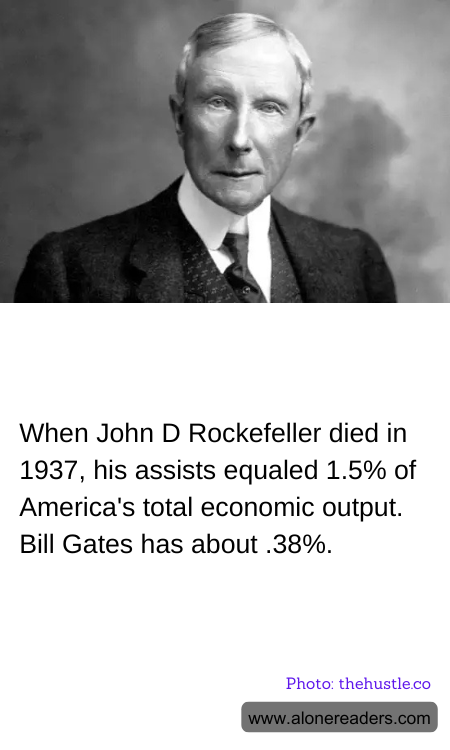
John D. Rockefeller’s financial legacy is nothing short of legendary. It is estimated that at the time of his death in 1937, his assets amounted to about 1.5% of America’s total economic output, a testament to his unmatched dominance in the oil industry and his astute investments. As a co-founder of Standard Oil in 1870, Rockefeller revolutionized the petroleum industry and established what would become the first great U.S. business trust. This empire controlled almost all oil production, processing, marketing, and transportation in the United States at its peak.
Rockefeller's wealth, in today’s terms, often places him as one of the richest individuals in modern history. His fortune was so vast that it dwarfed the economic output of the entire country in relative terms, illustrating the immense power and influence he wielded in the American economy.
Comparatively, modern billionaires like Bill Gates command significant wealth, but the scale is quite different. Bill Gates, who co-founded Microsoft in 1975, became one of the pivotal figures in the tech boom and eventually one of the richest individuals in the world. As of recent estimates, Gates' wealth is about 0.38% of the current U.S. GDP. Although this is an extraordinarily large percentage, it is significantly less than Rockefeller's share of the economic output during his time.
This difference in scale between Gates and Rockefeller highlights the changing nature of wealth and influence. While Rockefeller’s assets were heavily tied to America’s industrial growth, driven by tangible goods and monopolistic control over oil, Gates’ wealth originates from the technology sector, characterized by software development and intellectual property.
Despite the different times and sectors, both figures exemplify the enormous impact that individual entrepreneurs can have on their country’s economy and beyond. Rockefeller’s and Gates' legacies continue to shape economic and philanthropic spheres, illustrating the evolving nature of wealth and power in American history.