More About This Card
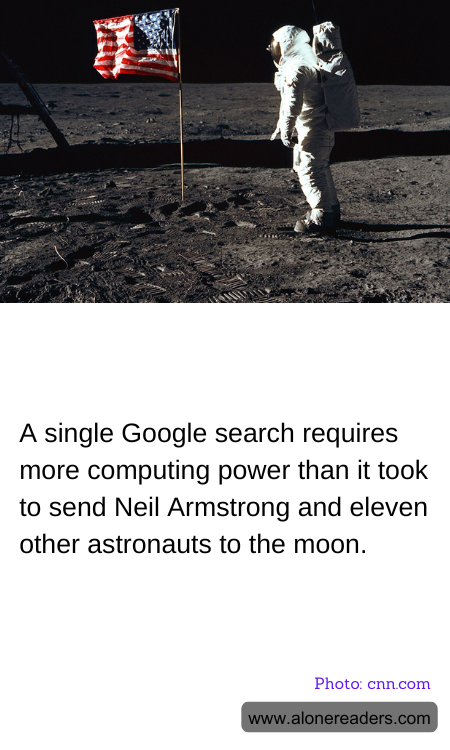
The evolution of computing power over the past few decades is nothing short of astonishing. A particularly striking example of this is the comparison between the computational capabilities required for a single Google search and the technology used during the Apollo missions, which successfully landed astronauts on the moon. The computers aboard Apollo 11, such as the Apollo Guidance Computer (AGC), had a processor running at 0.043 MHz and about 64KB of memory. This setup was revolutionary at the time, guiding one of humanity's most significant achievements, but it pales in comparison to the technology we carry in our pockets today.
When you perform a simple Google search from your computer or smartphone, the computational requirements are vastly greater than those of the AGC. Modern devices use processors that are millions of times more powerful. Moreover, a Google search isn't just about the device in your hand; it involves a more complex process that includes data retrieval from servers, which themselves are part of vast data centers equipped with highly advanced computing technologies. These servers analyze vast amounts of data, apply complex algorithms, and bring you the most relevant results in a fraction of a second.
Google's data centers, which are spread around the world, comprise thousands of servers with capabilities that were unimaginable during the era of the moon landings. They handle exabytes of data daily, including indexing and retrieving information, personal data management, and running various services such as email and real-time collaboration tools. Each query goes through multiple layers of processing, including interpreting the query, searching the index, and ranking the results based on relevance and other factors.
This immense growth in computing power reflects broader trends in technology, particularly the exponential increase described by Moore's Law, which states that the number of transistors on a microchip doubles about every two years, though the pace has slowed slightly in recent years. This growth has enabled not only more powerful computational tasks but the birth of new technologies and industries, from artificial intelligence and big data analytics to personalized medicine and autonomous vehicles, which all rely on far greater computational power than was available during the Apollo missions.
Considering this, the comparison between a Google search and the Apollo guidance systems is not just a reflection on how far computing has come, but it also highlights the transformative impact of digital technology on society. It's a testament to human ingenuity and an ever-pressing push towards the unknown, much like the spirit that propelled those early astronauts towards the moon.