More About This Card
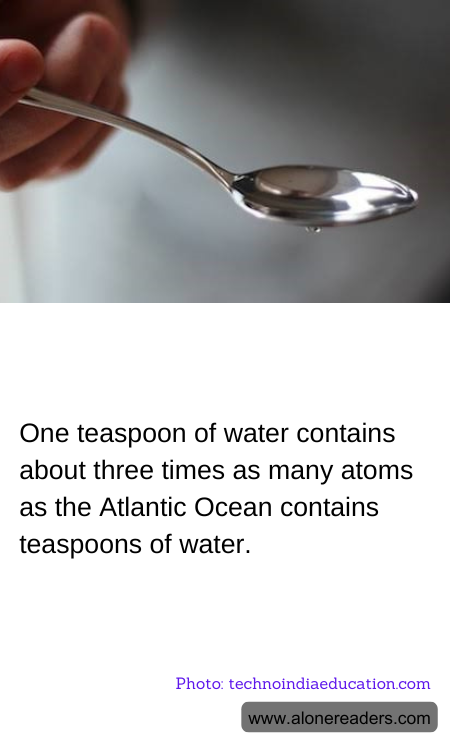
In the vast realm of science, certain facts can be both mind-boggling and awe-inspiring. One such fact is that a single teaspoon of water contains approximately three times as many atoms as there are teaspoons of water in the entire Atlantic Ocean. This comparison not only highlights the immense scale of atomic structures but also offers a fascinating glimpse into the world of chemistry and physics.
To understand this concept, we must first consider the composition of water. A water molecule is made up of two hydrogen atoms and one oxygen atom, forming the familiar H2O. Each of these atoms is incredibly small, with a single water molecule measuring about 0.275 nanometers in diameter. When you consider that a teaspoon of water contains around 5 milliliters, or approximately 5 grams, the number of water molecules in that small volume is staggering. In fact, there are about 1.67 x 10^23 water molecules in a single teaspoon.
Now, let's compare this to the Atlantic Ocean. The Atlantic is one of the largest bodies of water on Earth, covering an area of about 106.5 million square kilometers and holding approximately 310 million cubic kilometers of water. If you were to convert this volume into teaspoons, you would find that the Atlantic Ocean contains roughly 4.5 x 10^21 teaspoons of water. While this number is undeniably vast, it pales in comparison to the number of atoms in just one teaspoon of water.
This comparison serves as a humbling reminder of the scale at which atomic and molecular structures operate. Atoms are the building blocks of matter, and their sheer number in even the smallest quantities of substances underscores the complexity and intricacy of the natural world. It also highlights the importance of scientific inquiry and exploration, as understanding these fundamental components of matter can lead to advancements in technology, medicine, and environmental science.
For many, the idea that something as commonplace as a teaspoon of water can contain such an astronomical number of atoms is a testament to the wonders of science. It encourages curiosity and a deeper appreciation for the world around us. Whether you're a student, a scientist, or simply someone with a thirst for knowledge, contemplating the vastness of the atomic world can inspire a sense of wonder and a desire to learn more about the universe we inhabit.
In conclusion, the comparison between the number of atoms in a teaspoon of water and the number of teaspoons in the Atlantic Ocean is more than just a fun fact; it is a gateway to understanding the incredible intricacies of the natural world. It reminds us that even the most ordinary objects can hold extraordinary secrets, waiting to be discovered by those who dare to look closer.