More About This Card
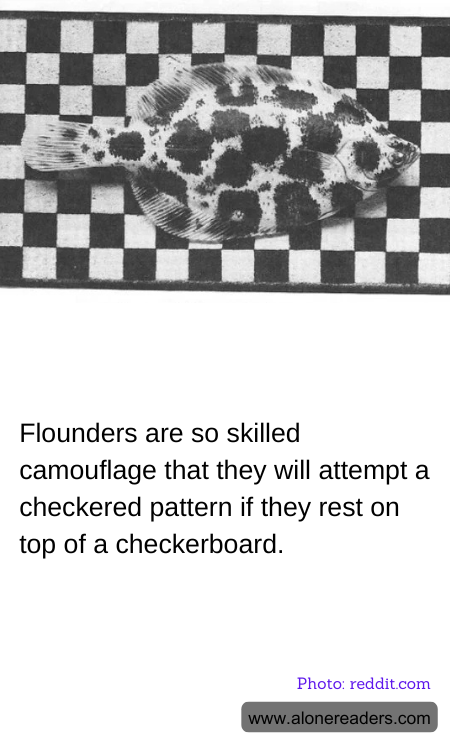
In the fascinating world of marine life, few creatures are as adept at the art of camouflage as the flounder. These flatfish, with their unique ability to blend seamlessly into their surroundings, have captivated scientists and nature enthusiasts alike. One of the most intriguing aspects of their camouflage capabilities is their ability to mimic complex patterns, such as the checkered design of a checkerboard, when they rest upon it.
Flounders are masters of disguise, a skill that has evolved over millions of years to help them evade predators and ambush prey. Their bodies are uniquely adapted for life on the ocean floor, with both eyes located on one side of their head, allowing them to lie flat against the seabed while keeping a watchful eye on their environment. This adaptation is complemented by their remarkable ability to change the color and pattern of their skin to match their surroundings.
The flounder's skin contains specialized cells called chromatophores, which can expand or contract to alter the fish's coloration. This allows them to mimic the textures and hues of sand, rocks, and even intricate patterns like the checkerboard. When a flounder finds itself on a checkerboard, it will attempt to replicate the alternating black and white squares, a testament to its sophisticated camouflage skills. This ability is not just a simple color change; it involves a complex interaction between the fish's nervous system and its skin cells, enabling it to produce a highly detailed and accurate representation of its environment.
This remarkable camouflage ability serves as a crucial survival mechanism for flounders. By blending into their surroundings, they can avoid detection by predators such as larger fish and birds. At the same time, it allows them to stealthily approach their prey, which includes small fish and crustaceans, without being noticed. The flounder's camouflage is so effective that it can remain virtually invisible to both predators and prey, making it one of the ocean's most elusive inhabitants.
The flounder's ability to mimic a checkerboard pattern is not only a marvel of nature but also a reminder of the incredible adaptability and resourcefulness of marine life. It highlights the intricate and often surprising ways in which animals have evolved to survive in their environments. For those lucky enough to witness this phenomenon, it serves as a vivid illustration of the wonders of the natural world and the endless possibilities of evolution.
In conclusion, the flounder's skillful camouflage is a testament to the ingenuity of nature. Its ability to replicate complex patterns like a checkerboard is a fascinating example of how animals have adapted to their environments in extraordinary ways. Whether lying on the ocean floor or atop a checkerboard, the flounder remains a master of disguise, captivating all who have the chance to observe its remarkable talents.