More About This Card
In the wake of the French Revolution, a period marked by radical social and political upheaval, France embarked on an ambitious project to redefine not only its governance but also the very way its citizens perceived time. In 1792, the French Republican Calendar was introduced, a bold attempt to break away from the Gregorian calendar and the religious and royal associations it carried. This new calendar was part of a broader effort to secularize and rationalize French society, aligning it with the revolutionary ideals of liberty, equality, and fraternity.
The French Republican Calendar was unique in its structure. It divided the year into 12 months, each consisting of three weeks, known as "décades," with each week containing 10 days. This was a significant departure from the seven-day week that had been in use for centuries. The months were named to reflect the seasonal characteristics of the French climate, such as Vendémiaire (grape harvest) and Thermidor (heat). This change was intended to create a more logical and nature-oriented system, distancing the calendar from religious connotations.
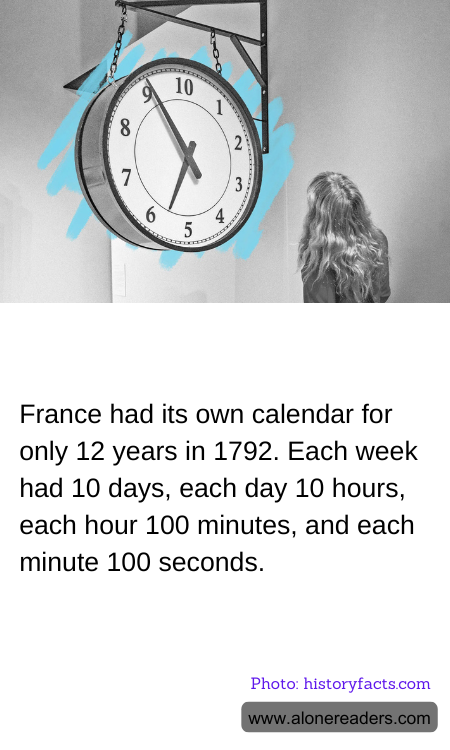
Each day in this calendar was divided into 10 hours, each hour into 100 minutes, and each minute into 100 seconds. This decimal time system was designed to simplify timekeeping and align it with the metric system, which was also being introduced during this period. The idea was to create a more uniform and rational system that could be easily understood and adopted by the populace. However, the decimal time system proved to be one of the more challenging aspects of the calendar for people to adapt to, as it required a complete overhaul of existing timekeeping practices.
Despite its innovative approach, the French Republican Calendar faced numerous challenges. The 10-day week was unpopular, particularly among workers, as it extended the period between rest days. Additionally, the calendar's secular nature was met with resistance from religious communities who were accustomed to the traditional seven-day week with Sunday as a day of rest and worship. The practical difficulties of implementing a new time system, coupled with the political instability of the era, made widespread adoption difficult.
After 12 years, the French Republican Calendar was officially abandoned in 1806 by Napoleon Bonaparte, who reinstated the Gregorian calendar. The experiment, while short-lived, remains a fascinating example of how revolutionary ideals can extend into all aspects of life, including the very way time is measured. It serves as a reminder of the complexities involved in altering deeply ingrained societal structures and the challenges of implementing radical change.
Today, the French Republican Calendar is a historical curiosity, a testament to the revolutionary spirit of the era and the lengths to which the revolutionaries were willing to go to reshape society. It highlights the interplay between politics, culture, and time, and the enduring human quest to find order and meaning in the passage of days.