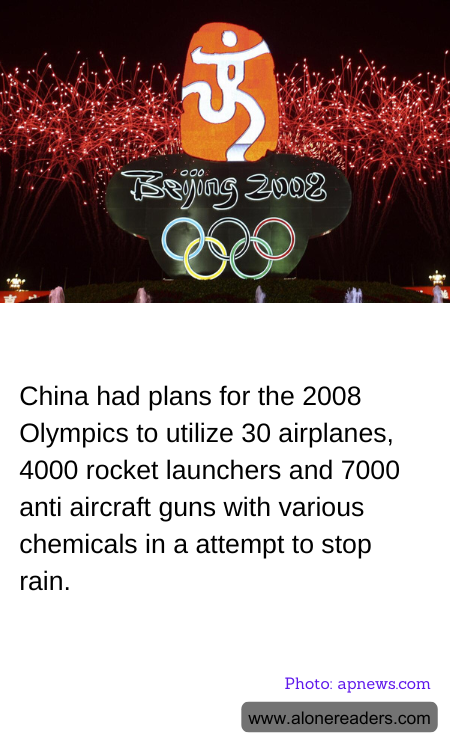
In the summer of 2008, Beijing was the epicenter of global attention as it hosted the Olympic Games, a prestigious event that required meticulous planning and execution. Among the myriad of preparations, one of the most intriguing and ambitious was China's plan to control the weather. Determined to ensure that the opening ceremony and subsequent events were not marred by rain, China devised a comprehensive strategy involving 30 airplanes, 4,000 rocket launchers, and 7,000 anti-aircraft guns, all equipped with various chemicals designed to manipulate the weather.
Weather modification, particularly cloud seeding, is not a novel concept. It involves dispersing substances into the atmosphere to encourage or suppress precipitation. For the 2008 Olympics, China aimed to prevent rain by using silver iodide and other chemicals to induce early rainfall, thereby clearing the skies over Beijing. The idea was to seed clouds before they reached the city, causing them to release their moisture prematurely and ensuring clear skies during the events.
The scale of this operation was unprecedented. The deployment of 30 airplanes and thousands of rocket launchers and anti-aircraft guns underscored the lengths to which China was willing to go to guarantee a flawless Olympic experience. The plan was not only a testament to China's technological capabilities but also a reflection of its commitment to showcasing the nation on the world stage. The Chinese government invested heavily in this endeavor, training personnel and coordinating efforts across multiple regions to execute the plan seamlessly.
While the concept of weather modification raises questions about environmental impact and ethical considerations, China's efforts during the 2008 Olympics were largely successful. The opening ceremony proceeded without a hitch, with clear skies providing a perfect backdrop for the spectacular display. This achievement was hailed as a triumph of human ingenuity and a demonstration of China's ability to harness technology for national prestige.
However, the use of such extensive resources for weather control also sparked debates about the implications of human intervention in natural processes. Critics argued that manipulating the weather could have unforeseen consequences, potentially disrupting ecosystems and affecting regions beyond the targeted areas. Despite these concerns, the 2008 Olympics remain a landmark event in the history of weather modification, illustrating both the potential and the challenges of such ambitious undertakings.
In retrospect, China's weather modification efforts for the 2008 Olympics serve as a fascinating case study in the intersection of technology, environment, and international spectacle. It highlights the lengths to which nations might go to ensure the success of globally significant events and raises important questions about the future of weather control in an increasingly unpredictable climate.
