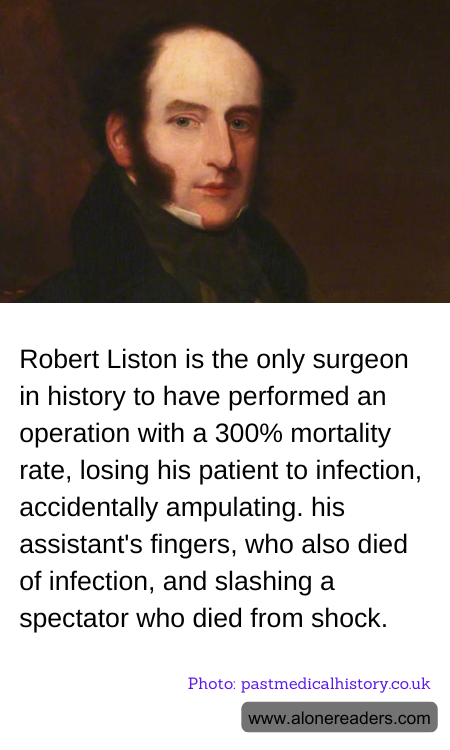
More About This Card
In the annals of medical history, few figures are as simultaneously celebrated and notorious as Robert Liston, a pioneering 19th-century surgeon known for his speed and skill in an era before anesthesia. However, one of his most infamous operations is remembered not for its success, but for its tragic and bizarre outcome: a 300% mortality rate.
Robert Liston was a larger-than-life character, renowned for his ability to perform amputations in mere minutes, a crucial skill in a time when patients were fully conscious and suffering was immense. His reputation as "the fastest knife in the West End" was well-earned, and he was often called upon to perform surgeries that others deemed too risky. Yet, it was during one of these high-stakes procedures that Liston inadvertently made history for all the wrong reasons.
The operation in question was a leg amputation, a common procedure in Liston's day due to the prevalence of infections and injuries that left limbs unsalvageable. As Liston set to work, his focus on speed led to a series of catastrophic errors. In his haste, he accidentally amputated the fingers of his young assistant, who was holding the patient steady. The assistant later succumbed to infection, a common and often deadly complication in the pre-antiseptic era.
The chaos did not end there. During the frenetic procedure, Liston also managed to slash the coat of a spectator, a distinguished gentleman who had come to observe the surgery. The shock of the incident was so overwhelming that the spectator reportedly died of fright on the spot. Tragically, the patient himself did not survive the operation, falling victim to postoperative infection, a fate all too common in those days.
This ill-fated surgery, with its three fatalities, became a grim legend in medical circles, illustrating the perilous nature of surgery before the advent of modern antiseptic techniques and anesthesia. It serves as a stark reminder of the challenges faced by surgeons of the past and the incredible strides made in medical science since then.
Despite this notorious incident, Robert Liston is also remembered for his contributions to surgical practice, including his advocacy for the use of ether as an anesthetic, which revolutionized surgery and significantly improved patient outcomes. His legacy is a complex tapestry of innovation and tragedy, reflecting the turbulent evolution of medicine in the 19th century.
The story of Liston's 300% mortality rate operation is a poignant chapter in the history of surgery, highlighting both the human cost of medical advancement and the relentless pursuit of progress that defines the field. It reminds us of the importance of precision, care, and the profound impact of medical innovation on human lives.