More About This Card
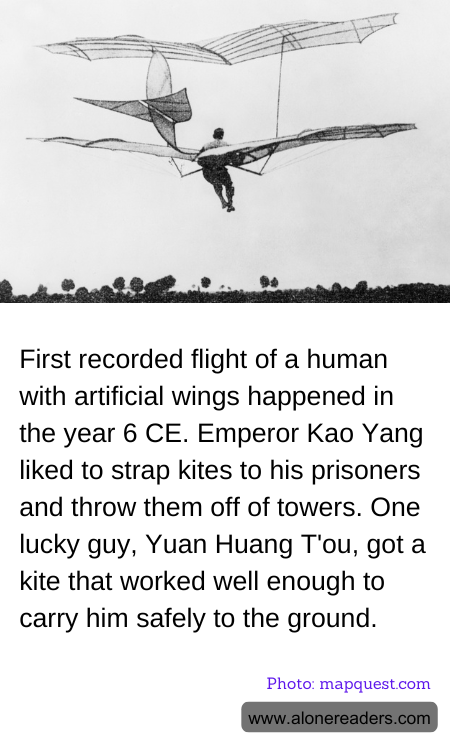
In the annals of human history, the dream of flight has always captured the imagination. While the Wright brothers are often credited with the first successful powered flight in 1903, the concept of humans taking to the skies dates back much further. One of the earliest recorded instances of human flight, albeit in a rather unconventional manner, occurred in the year 6 CE during the reign of Emperor Kao Yang of the Northern Wei dynasty in China.
Emperor Kao Yang, known for his eccentric and often cruel methods of punishment, devised a unique form of entertainment and execution. He would strap kites to the backs of prisoners and hurl them from the tops of towers. This grim spectacle was intended to amuse the court and demonstrate the emperor's power over life and death. However, in a twist of fate, one prisoner named Yuan Huang T'ou experienced an unexpected outcome.
Yuan Huang T'ou, unlike his unfortunate predecessors, was given a kite that was remarkably well-constructed. As he was launched from the tower, the kite caught the wind perfectly, allowing him to glide gracefully to the ground. This unexpected success marked the first recorded instance of a human achieving flight with the aid of artificial wings. Yuan's survival was not only a testament to the potential of human ingenuity but also a rare moment of triumph in a time when such experiments often ended in tragedy.
The story of Yuan Huang T'ou is a fascinating glimpse into the early attempts at human flight. It highlights the enduring human desire to conquer the skies, a dream that has persisted through the ages. While the methods employed by Emperor Kao Yang were undoubtedly brutal, they inadvertently paved the way for future innovations in aviation. Yuan's successful flight demonstrated that with the right design and conditions, humans could indeed soar above the earth.
Today, the tale of Yuan Huang T'ou serves as a reminder of the resilience and creativity inherent in the human spirit. It underscores the lengths to which people have gone to achieve the seemingly impossible and the unexpected ways in which progress can occur. As we continue to explore the skies and beyond, the story of this early aviator remains an inspiring chapter in the long history of human flight.