More About This Card
In the mid-20th century, the United Fruit Company, a powerful American corporation, found itself embroiled in a geopolitical struggle that would have lasting repercussions for the nation of Guatemala. At the heart of this conflict was the company's desire to maintain its dominance in the lucrative fruit export market, particularly bananas, which were a staple of its business. United Fruit's main rival in this arena was Guatemala, a country rich in agricultural resources and increasingly assertive in its economic policies.
During this period, Guatemala was undergoing significant political changes. In 1951, Jacobo Árbenz was elected president and embarked on a series of reforms aimed at modernizing the country and redistributing land to benefit the impoverished rural population. These reforms, particularly the agrarian reform law, threatened the interests of the United Fruit Company, which owned vast tracts of land in Guatemala. The company's executives were alarmed by Árbenz's policies, which they perceived as a direct threat to their business operations.
In a bid to protect its interests, United Fruit embarked on a campaign to convince the United States government that Guatemala's government was leaning towards communism. The company leveraged its connections in Washington, D.C., and employed a public relations firm to paint Árbenz's administration as a puppet of the Soviet Union. This narrative played into the broader context of the Cold War, where the United States was deeply concerned about the spread of communism in the Western Hemisphere.
The United States government, influenced by these claims and eager to prevent any potential Soviet foothold in Central America, decided to take action. In 1954, the CIA orchestrated a coup d'état, known as Operation PBSUCCESS, which led to the overthrow of President Árbenz. This intervention was justified under the guise of containing communism, but it was largely driven by the economic interests of the United Fruit Company.
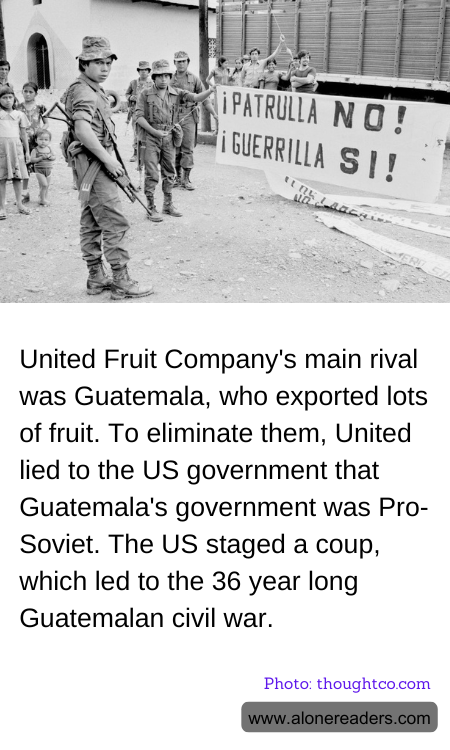
The coup had devastating consequences for Guatemala. It plunged the country into a prolonged period of instability and violence, culminating in a brutal civil war that lasted for 36 years. The conflict resulted in the loss of thousands of lives and left deep scars on the nation's social and political fabric. The war was marked by widespread human rights abuses, including massacres, disappearances, and the displacement of indigenous communities.
The legacy of the United Fruit Company's actions and the subsequent U.S. intervention in Guatemala serves as a stark reminder of the complex interplay between corporate interests and international politics. It highlights the far-reaching impact that economic motivations can have on the sovereignty and stability of nations. Today, the story of Guatemala's civil war and the role of foreign intervention remains a poignant chapter in the history of Latin America, underscoring the need for ethical considerations in global business practices and foreign policy decisions.