More About This Card
Adolf Hitler's vision for Berlin was nothing short of monumental. During the height of World War II, he and his chief architect, Albert Speer, devised an ambitious plan to transform Berlin into a neo-Roman cosmopolitan city that would serve as the capital of a new world order. This grandiose project, known as "Welthauptstadt Germania," was intended to reflect the power and glory of the Third Reich, drawing inspiration from the architectural magnificence of ancient Rome.
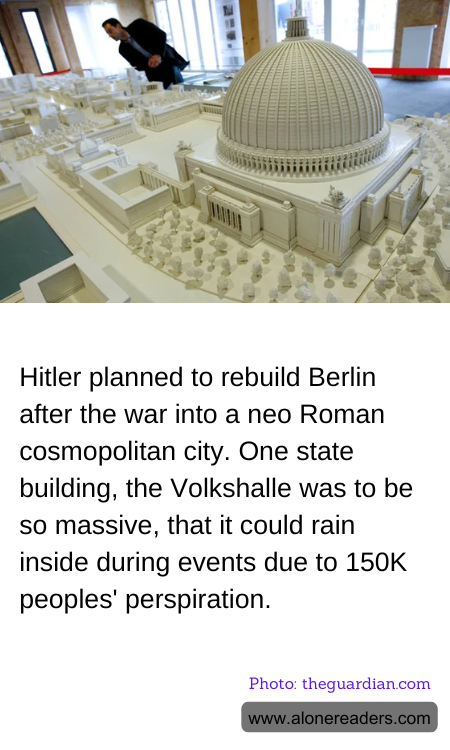
Central to this vision was the construction of the Volkshalle, or the "People's Hall." This colossal structure was designed to be the centerpiece of the new Berlin, symbolizing the might and unity of the German people. The Volkshalle was planned to be so vast that it could accommodate up to 150,000 people under its enormous dome. The scale of the building was unprecedented, with the dome alone towering at a height of 290 meters, making it one of the largest enclosed spaces ever conceived.
The sheer size of the Volkshalle led to some intriguing and unusual considerations. One of the most remarkable aspects of the design was the expectation that the collective body heat and perspiration of the thousands of attendees could create its own microclimate inside the hall. It was speculated that during large gatherings, the condensation from the perspiration could lead to rain falling inside the building. This phenomenon underscores the immense scale and ambition of the project, highlighting the lengths to which Hitler and Speer were willing to go to create a symbol of their envisioned empire.
Despite the detailed planning and the allocation of resources, the project never came to fruition. The tides of war turned against Nazi Germany, and the resources that were initially earmarked for the construction of Germania were redirected to the war effort. The devastation of Berlin by Allied bombings further dashed any hopes of realizing this grand architectural dream. In the aftermath of the war, the plans for Germania were abandoned, and the city of Berlin was left to rebuild itself in a much different context.
Today, the story of Hitler's plans for Berlin serves as a stark reminder of the ambitions and hubris of the Nazi regime. The Volkshalle, with its potential for indoor rain, remains a symbol of the extreme lengths to which totalitarian regimes may go in their quest for power and legacy. While the physical structures never materialized, the plans continue to fascinate historians and architects alike, offering a glimpse into a world that might have been, had history taken a different course.