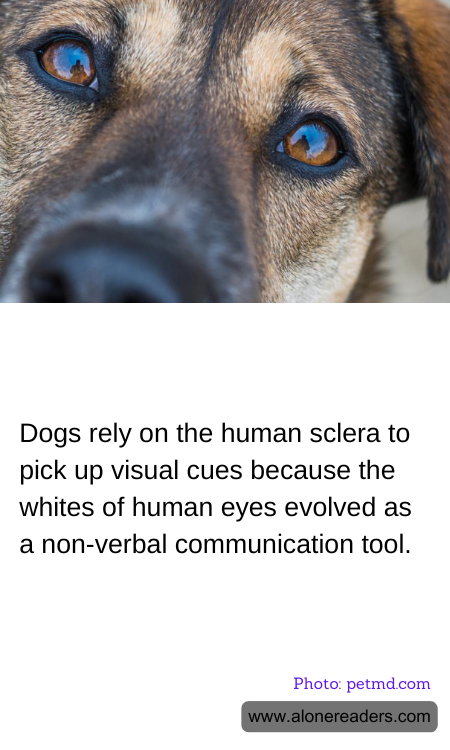
Dogs have long been considered man's best friend, and their ability to understand and communicate with humans is a testament to this enduring bond. One fascinating aspect of this interspecies communication is how dogs rely on the human sclera, the whites of our eyes, to pick up visual cues. This unique feature of human anatomy has evolved as a non-verbal communication tool, playing a crucial role in our interactions with dogs.
The sclera is a prominent part of the human eye, contrasting sharply with the colored iris and the dark pupil. This distinct contrast is not as pronounced in many other animals, whose sclera often matches the color of their irises, making it less visible. The evolution of the human sclera as a communication tool is believed to have developed to enhance non-verbal communication among humans, allowing us to convey emotions and intentions through subtle eye movements and expressions.
Dogs, with their keen observational skills, have adapted to interpret these visual cues from humans. Research has shown that dogs are remarkably adept at following the direction of human gaze, understanding where we are looking, and even discerning our emotional states based on our eyes. This ability is not just a result of domestication but also a testament to the deep-rooted connection between humans and dogs, forged over thousands of years of cohabitation and cooperation.
The ability of dogs to read human eyes is particularly evident in their interactions with us. For instance, when a dog wants to play or needs attention, it often looks directly into a human's eyes, seeking a response. Similarly, dogs can sense when a person is upset or happy by observing the changes in their eyes, responding with comforting gestures or playful antics accordingly. This mutual understanding enhances the bond between humans and dogs, making communication more intuitive and effective.
Moreover, the human sclera's role in communication extends beyond just dogs. It is a vital part of how humans interact with each other, allowing us to convey complex emotions and intentions without uttering a single word. This non-verbal communication is crucial in social interactions, helping to build trust and understanding among individuals.
In conclusion, the evolution of the human sclera as a non-verbal communication tool has not only enriched human interactions but also strengthened our relationship with dogs. By relying on the visual cues provided by the whites of our eyes, dogs have become adept communicators, capable of understanding and responding to our emotions and intentions. This remarkable ability underscores the deep connection between humans and dogs, highlighting the importance of non-verbal communication in fostering strong, meaningful relationships across species.
