More About This Card
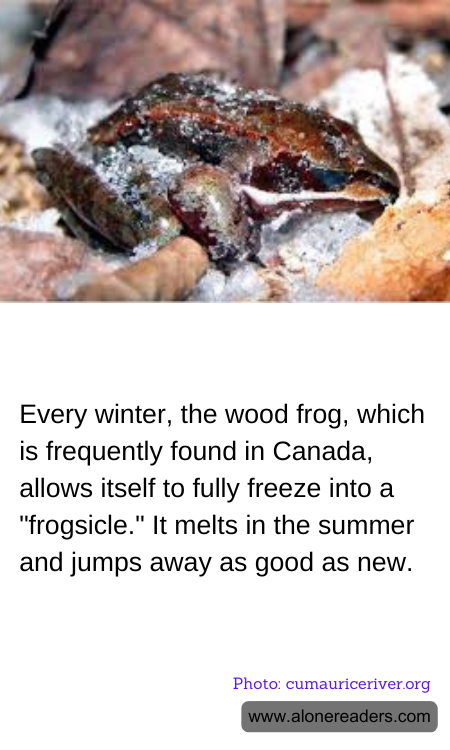
In the heart of the Canadian wilderness, a remarkable amphibian performs a wintertime feat that seems more like science fiction than reality. The wood frog, a small and unassuming creature, has developed an extraordinary survival strategy that allows it to endure the harshest of winters. As temperatures plummet and snow blankets the ground, the wood frog undergoes a transformation that turns it into a "frogsicle," a term affectionately coined to describe its frozen state.
Unlike most animals that seek shelter from the cold, the wood frog embraces the freeze. As winter approaches, it begins a process of self-preservation that involves the complete cessation of its bodily functions. The frog's heart stops beating, its breathing halts, and its body becomes as solid as ice. This frozen state is not merely a deep sleep; it is a complete suspension of life processes. The wood frog's ability to survive this frozen state is due to a unique biological adaptation. As the temperature drops, the frog's liver produces large amounts of glucose, which acts as a natural antifreeze. This glucose is distributed throughout the frog's body, preventing ice crystals from forming inside its cells, which would otherwise cause lethal damage.
For months, the wood frog remains in this suspended animation, buried beneath layers of snow and ice. It is a testament to nature's ingenuity, a living paradox that defies the conventional understanding of life and death. As spring arrives and the world begins to thaw, so too does the wood frog. Slowly, its body warms, and the ice within it melts. Remarkably, the frog's heart begins to beat once more, and it resumes breathing. Within a short time, the wood frog is hopping about as if nothing extraordinary has occurred.
This incredible adaptation not only allows the wood frog to survive the winter but also provides scientists with valuable insights into the possibilities of cryopreservation. The study of the wood frog's natural antifreeze mechanisms could have far-reaching implications, potentially informing medical advancements in organ preservation and even space travel.
The wood frog's annual transformation from a frozen state back to vibrant life is a reminder of the resilience and adaptability of nature. It highlights the wonders of evolution and the intricate ways in which life on Earth has adapted to survive in even the most extreme conditions. For those fortunate enough to witness the wood frog's revival each spring, it is a spectacle that underscores the beauty and mystery of the natural world. As the wood frog leaps into the warmth of the new season, it carries with it a story of survival that continues to captivate and inspire.