More About This Card
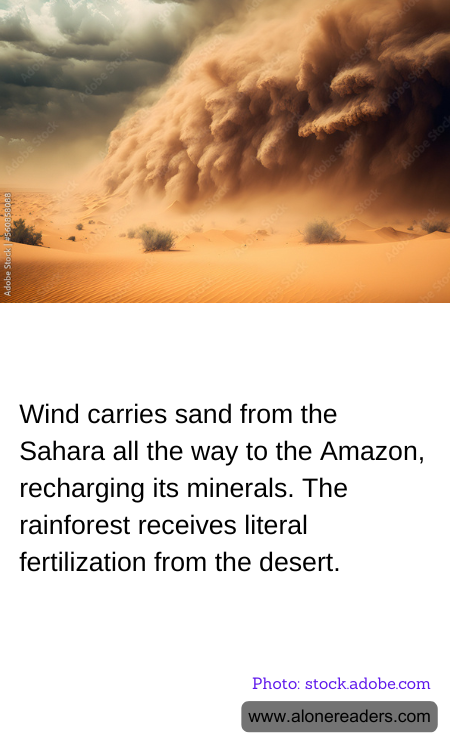
In a remarkable demonstration of nature's interconnectedness, the Sahara Desert, one of the driest places on Earth, plays a crucial role in sustaining the lush Amazon Rainforest, thousands of miles away. This fascinating phenomenon occurs through the transatlantic journey of dust particles carried by the wind, which fertilizes the Amazon with essential minerals.
The Sahara Desert, spanning approximately 9.2 million square kilometers, is a vast expanse of sand and rock. Despite its arid conditions, it is a significant source of dust, with winds lifting millions of tons of fine particles into the atmosphere each year. These particles, rich in phosphorus and other nutrients, embark on a long journey across the Atlantic Ocean, propelled by trade winds.
As the dust travels, it forms a massive plume that can be seen from space, stretching over 5,000 kilometers. This journey is not only a testament to the power of natural forces but also a vital ecological process. When the dust finally settles over the Amazon Basin, it acts as a natural fertilizer, replenishing the soil with nutrients that are otherwise scarce in the rainforest.
Phosphorus, a key component of the Saharan dust, is particularly important for the Amazon's ecosystem. It is a critical nutrient for plant growth, yet it is often limited in tropical rainforest soils due to heavy rainfall that washes nutrients away. The annual deposition of Saharan dust helps to offset this loss, ensuring that the Amazon remains one of the most biodiverse regions on the planet.
This natural fertilization process highlights the intricate balance of Earth's ecosystems and the surprising ways in which they are interconnected. The Sahara's contribution to the Amazon is a reminder of the global nature of environmental processes and the importance of preserving these natural cycles.
Moreover, this phenomenon underscores the significance of understanding and protecting our planet's delicate ecosystems. As climate change and human activities continue to alter natural patterns, it is crucial to recognize the interconnectedness of different regions and the potential impacts on global biodiversity.
The journey of Saharan dust to the Amazon is a captivating example of nature's resilience and adaptability. It serves as a powerful reminder that even the most unlikely connections can have profound effects on the health and sustainability of our planet. By appreciating and studying these natural processes, we can better understand the complex web of life that sustains us all.