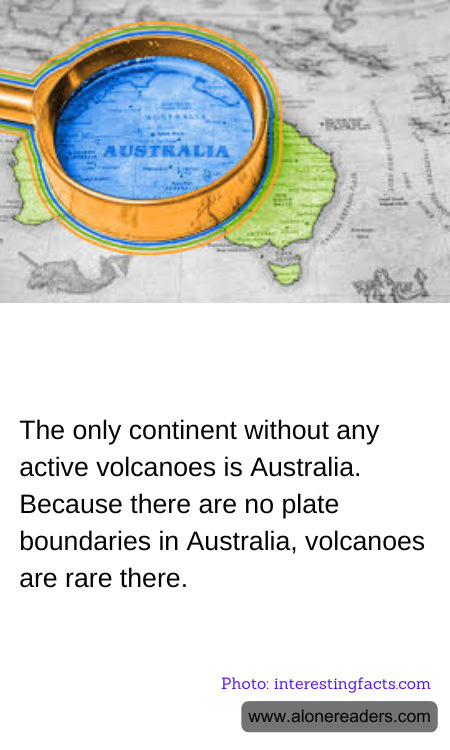
Australia, the world's smallest continent, is unique in many ways, not least because it is the only continent without any active volcanoes. This geological peculiarity is primarily due to the absence of plate boundaries within the continent. Unlike other continents that are often crisscrossed by tectonic plate boundaries, which are hotspots for volcanic activity, Australia's landmass is situated squarely in the middle of the Indo-Australian Plate. This stable position means that the dramatic geological upheavals that create volcanoes are rare in this region.
Volcanoes typically form along tectonic plate boundaries where plates either converge, diverge, or slide past one another. These movements create the conditions necessary for magma from the Earth's mantle to reach the surface, resulting in volcanic eruptions. In contrast, Australia's location away from these dynamic boundaries means that the geological forces required to produce active volcanoes are largely absent. This stability has allowed Australia to develop a landscape that is geologically distinct from other continents, characterized by vast deserts, ancient mountain ranges, and expansive plains.
While Australia does not have any active volcanoes, it is not entirely devoid of volcanic history. The continent has experienced volcanic activity in the distant past, with the most recent eruptions occurring thousands of years ago. The remnants of these ancient volcanoes can still be seen today in the form of extinct volcanic cones and craters scattered across the landscape. For instance, the volcanic region of Victoria and the Atherton Tableland in Queensland are home to numerous dormant volcanic features that serve as a testament to the continent's fiery past.
The lack of active volcanoes in Australia has several implications for its environment and inhabitants. For one, it means that Australians do not have to contend with the immediate dangers posed by volcanic eruptions, such as lava flows, ash clouds, and pyroclastic surges. This geological stability contributes to a relatively predictable and safe environment, which is beneficial for agriculture, infrastructure, and urban development. Moreover, the absence of active volcanoes allows for the preservation of unique ecosystems and biodiversity, as there is less disruption from volcanic activity.
In conclusion, Australia's position away from tectonic plate boundaries makes it a continent without active volcanoes, setting it apart from the rest of the world. This geological stability has shaped the continent's landscape and influenced its development, offering a unique environment that is both fascinating and safe. While the echoes of its volcanic past remain etched in its terrain, Australia continues to stand as a testament to the diverse and dynamic nature of our planet's geology.
