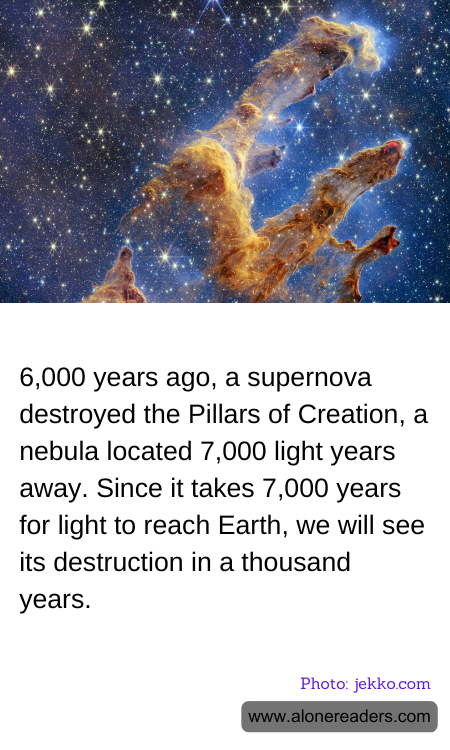
In the vast expanse of the universe, the Pillars of Creation stand as one of the most iconic celestial structures. Located within the Eagle Nebula, approximately 7,000 light-years from Earth, these towering columns of gas and dust have long captivated astronomers and stargazers alike. However, a cosmic event that occurred 6,000 years ago has sealed their fate, unbeknownst to us until now. A supernova, a powerful and luminous stellar explosion, obliterated these majestic pillars. Due to the immense distance, the light from this cataclysmic event is still traveling through space and will only reach Earth in about a thousand years.
The Pillars of Creation were first immortalized in a stunning image captured by the Hubble Space Telescope in 1995. These structures are not only visually striking but also serve as stellar nurseries, where new stars are born from the dense clouds of gas and dust. The supernova that destroyed them was likely a massive star that reached the end of its life cycle, collapsing under its own gravity and releasing an enormous amount of energy. This explosion would have sent shockwaves through the surrounding nebula, dispersing the material that formed the pillars.
The concept of witnessing an event that has already occurred thousands of years ago is a fascinating aspect of astronomy. Light, traveling at a speed of approximately 299,792 kilometers per second, takes time to traverse the vast distances of space. As a result, when we observe distant celestial objects, we are essentially looking back in time. In the case of the Pillars of Creation, the light from their destruction is still on its journey to Earth, and it will take another millennium before we can witness the aftermath of the supernova.
This impending revelation serves as a poignant reminder of the dynamic and ever-changing nature of the universe. While the destruction of the Pillars of Creation may seem like a loss, it is also a testament to the cycle of life and death that governs the cosmos. The material dispersed by the supernova will eventually contribute to the formation of new stars and planets, continuing the process of creation that defines our universe.
For now, the Pillars of Creation remain a symbol of the beauty and mystery of space, captured in images that continue to inspire wonder and curiosity. As we await the arrival of the light from their destruction, we are reminded of the incredible scale of the universe and our place within it. The story of the Pillars of Creation is a humbling reminder of the passage of time and the enduring legacy of cosmic events that shape the universe we call home.
