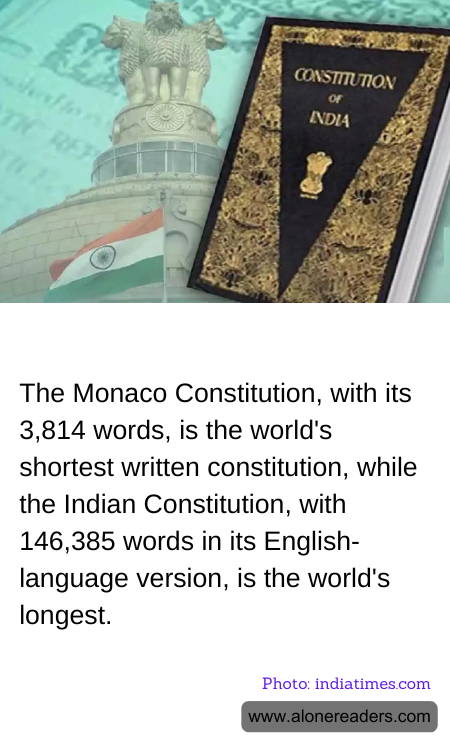
In the realm of constitutional law, the length of a nation's constitution can reflect its complexity, history, and the breadth of issues it seeks to address. Two striking examples of this are the constitutions of Monaco and India, which stand at opposite ends of the spectrum in terms of word count. Monaco's constitution, with a concise 3,814 words, is the world's shortest written constitution, while India's, with a staggering 146,385 words in its English-language version, holds the title for the longest.
Monaco, a small sovereign city-state located on the French Riviera, boasts a constitution that mirrors its size and simplicity. The brevity of Monaco's constitution can be attributed to its unique political and social structure. As a constitutional monarchy, Monaco's governance is heavily influenced by its royal family, which allows for a streamlined legal framework. The constitution, first adopted in 1911 and revised in 1962, outlines the powers of the Prince, the National Council, and the judiciary, while ensuring fundamental rights and freedoms for its citizens. Its succinct nature reflects the stability and continuity of Monaco's political system, which has remained largely unchanged for decades.
In stark contrast, the Indian Constitution is a comprehensive document that reflects the diversity and complexity of the world's largest democracy. Drafted by the Constituent Assembly and coming into effect on January 26, 1950, the Indian Constitution was designed to address the vast array of cultural, linguistic, and regional differences within the country. It encompasses a wide range of topics, including fundamental rights, directive principles of state policy, and the structure of government at both the central and state levels. The extensive nature of the document is a testament to the framers' intent to create a robust framework capable of governing a nation as diverse as India.
The length of India's constitution also highlights its adaptability. Over the years, it has been amended numerous times to address emerging issues and changing societal needs. This flexibility ensures that the constitution remains relevant and effective in guiding the nation through its evolving challenges. The detailed nature of the document provides a comprehensive legal foundation that supports India's democratic institutions and protects the rights of its citizens.
While the constitutions of Monaco and India differ significantly in length, both serve their respective nations effectively. Monaco's concise constitution reflects the stability and continuity of its governance, while India's extensive document underscores the complexity and diversity of its democratic system. These contrasting examples illustrate how constitutions can be tailored to meet the unique needs and circumstances of different countries, ensuring that they remain vital instruments of governance and justice.
