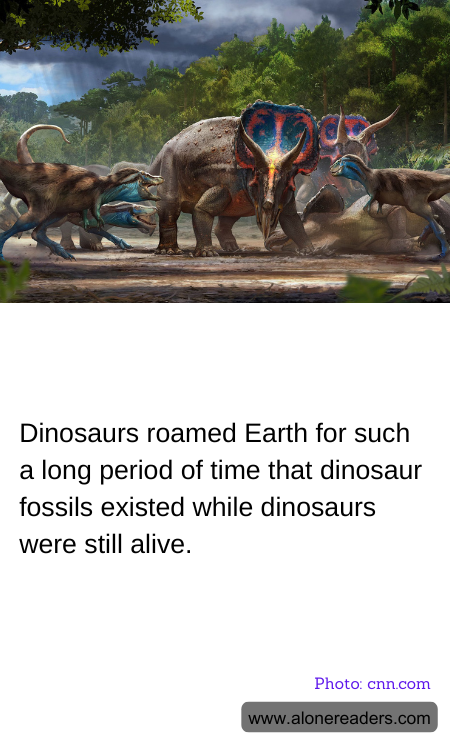
Dinosaurs, the magnificent creatures that once dominated our planet, roamed the Earth for an astonishingly long period of time. Spanning the Mesozoic Era, which lasted approximately 180 million years, dinosaurs thrived from the late Triassic period around 230 million years ago until the end of the Cretaceous period about 66 million years ago. This extensive timeline not only highlights their evolutionary success but also presents a fascinating concept: dinosaur fossils existed while dinosaurs were still alive.
The idea that dinosaur fossils were present during the time of living dinosaurs is a testament to the vastness of geological time. As dinosaurs lived and died over millions of years, their remains were buried and fossilized in sedimentary layers. Over time, these layers accumulated, creating a rich tapestry of fossilized remains that would eventually be uncovered by future generations. This means that as new species of dinosaurs evolved and roamed the Earth, they were walking over the remains of their ancient predecessors, unaware of the legacy they were leaving behind.
This phenomenon is not only intriguing but also provides valuable insights into the study of paleontology. Fossils are crucial for understanding the history of life on Earth, offering clues about the environment, climate, and ecosystems of the past. The presence of fossils from earlier periods during the time of living dinosaurs allowed for a continuous record of evolutionary changes and adaptations. This continuity helps scientists piece together the complex puzzle of how different dinosaur species evolved, interacted, and eventually became extinct.
Moreover, the existence of dinosaur fossils during the age of dinosaurs underscores the dynamic nature of Earth's geological processes. The constant shifting of tectonic plates, erosion, and sedimentation contributed to the burial and preservation of dinosaur remains. These processes ensured that fossils from different eras were layered upon one another, creating a stratified record that paleontologists can study today. This stratification allows scientists to date fossils accurately and understand the chronological sequence of dinosaur evolution.
The concept of dinosaurs living alongside the fossils of their ancestors also sparks the imagination. It invites us to ponder what it might have been like for these ancient creatures to inhabit a world where the past was literally beneath their feet. While dinosaurs themselves were likely oblivious to the fossilized remains of their forebears, their existence in such a world adds a layer of depth to our understanding of Earth's history.
In conclusion, the fact that dinosaur fossils existed while dinosaurs were still alive is a remarkable aspect of Earth's history. It highlights the longevity and success of these creatures and underscores the importance of fossils in unraveling the mysteries of the past. As we continue to study these ancient remains, we gain a deeper appreciation for the intricate tapestry of life that once flourished on our planet, reminding us of the ever-changing nature of the world we inhabit.
