More About This Card
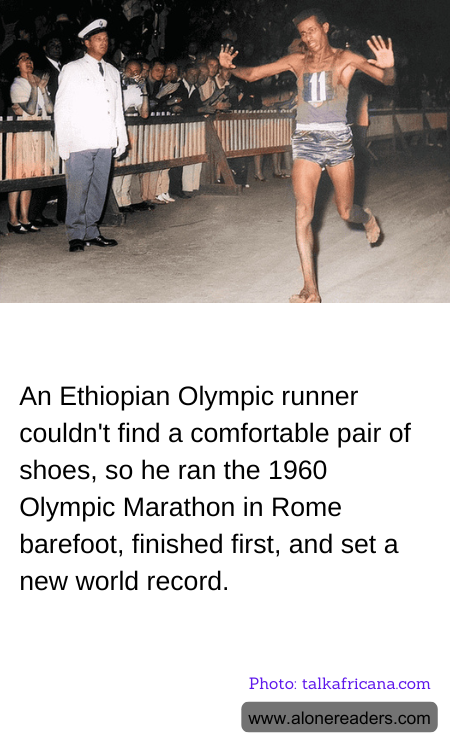
In the annals of Olympic history, few stories are as remarkable and inspiring as that of Abebe Bikila, the Ethiopian runner who defied convention and triumphed against all odds. In 1960, during the Rome Olympic Games, Bikila etched his name into the record books and the hearts of millions by winning the marathon in an unprecedented fashion—barefoot.
Born in the small village of Jato, Ethiopia, Bikila grew up in a country where running was not just a sport but a way of life. His journey to the Olympics was as extraordinary as his performance. Bikila was a member of the Imperial Guard of Ethiopia, and his talent was discovered by Onni Niskanen, a Swedish coach who was training the Ethiopian team. Despite his evident potential, Bikila faced a significant challenge just before the marathon: he could not find a pair of shoes that fit comfortably. The shoes provided by the Olympic sponsors were ill-suited for his feet, and rather than risk injury or discomfort, Bikila made the bold decision to run the marathon barefoot.
The marathon course in Rome was a grueling 26.2 miles, winding through the ancient streets and past historic landmarks. As the race began, few could have predicted the outcome. Bikila ran with a steady, determined pace, seemingly unfazed by the cobblestones and uneven surfaces. His decision to run barefoot was not just a testament to his resilience but also a nod to his roots, as he had often run without shoes in his homeland.
As the race progressed, Bikila's strategy became clear. He maintained a consistent speed, conserving energy for the final stretch. In the last few miles, he surged ahead, leaving his competitors in his wake. Bikila crossed the finish line at the Arch of Constantine in a time of 2 hours, 15 minutes, and 16.2 seconds, setting a new world record and becoming the first African to win an Olympic gold medal in the marathon.
Bikila's victory was more than just a personal triumph; it was a moment of immense pride for Ethiopia and a symbol of hope for the African continent. His achievement challenged stereotypes and demonstrated that talent and determination could overcome any obstacle. Bikila's barefoot run became a legendary tale of courage and perseverance, inspiring generations of athletes worldwide.
Abebe Bikila's legacy extends far beyond his Olympic victory. He went on to win another gold medal in the 1964 Tokyo Olympics, this time wearing shoes, proving that his success was not a fluke but the result of hard work and dedication. Bikila's story remains a powerful reminder that sometimes, the most extraordinary achievements come from the simplest acts of courage and conviction.