More About This Card
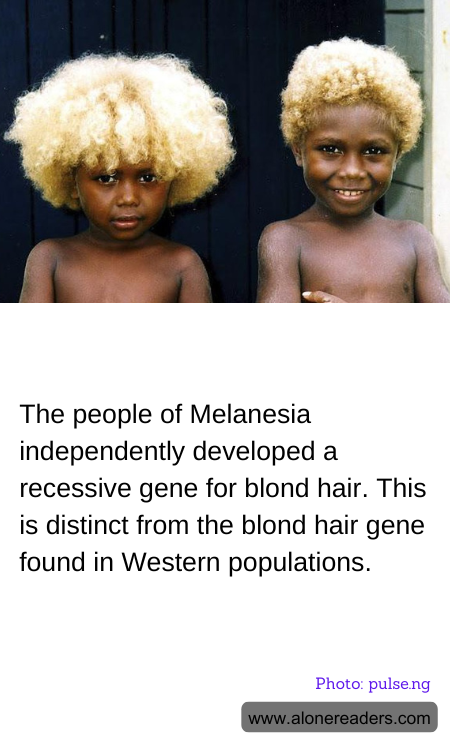
In the vast tapestry of human genetics, the people of Melanesia present a fascinating chapter. Nestled in the southwestern Pacific, Melanesia encompasses a group of islands including Papua New Guinea, Fiji, the Solomon Islands, and Vanuatu. Among the diverse populations inhabiting these islands, a unique genetic trait has captured the attention of scientists and laypeople alike: a recessive gene responsible for blond hair, distinct from the gene found in Western populations.
Blond hair is typically associated with European ancestry, particularly among those from Northern Europe. However, the Melanesian variant of blond hair is a striking example of convergent evolution, where similar traits evolve independently in separate populations. This phenomenon underscores the complexity and diversity of human genetics, revealing that nature can find multiple pathways to achieve similar outcomes.
The genetic basis for blond hair in Melanesians was uncovered through a study published in 2012, which identified a single nucleotide polymorphism (SNP) in the TYRP1 gene as the culprit. This gene is involved in the production of melanin, the pigment responsible for hair, skin, and eye color. The specific mutation found in Melanesians is not present in European populations, highlighting a distinct evolutionary path. This discovery was significant because it challenged the previously held notion that blond hair was solely a European trait, showcasing the rich genetic diversity present in human populations.
The presence of blond hair among Melanesians is not just a genetic curiosity but also a testament to the adaptability and resilience of human populations. It serves as a reminder that human evolution is not a linear process but rather a complex web of adaptations to diverse environments. The Melanesian blond hair gene likely arose as a random mutation that persisted in the population, possibly due to genetic drift or some unknown selective advantage.
This genetic trait also provides an opportunity to reflect on the broader implications of human diversity. It challenges stereotypes and assumptions about race and ethnicity, emphasizing that physical traits do not neatly align with our traditional categories of human classification. The Melanesian example illustrates that genetic diversity is a hallmark of the human species, with each population contributing uniquely to the human story.
In a world where globalization often blurs cultural and genetic boundaries, the Melanesian blond hair gene stands as a symbol of the rich tapestry of human diversity. It invites us to appreciate the myriad ways in which human populations have adapted to their environments and to celebrate the unique genetic heritage that each group brings to the global community. As we continue to explore the depths of human genetics, the story of the Melanesian blond hair gene reminds us of the endless possibilities and surprises that lie within our DNA.