More About This Card
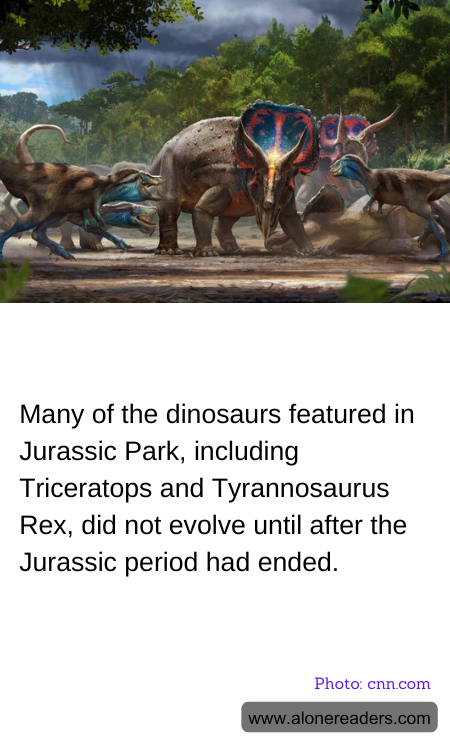
The iconic movie "Jurassic Park" has captivated audiences worldwide with its thrilling depiction of dinosaurs roaming the Earth. However, a fascinating fact often overlooked is that many of the dinosaurs featured in the film, such as the Triceratops and Tyrannosaurus Rex, did not actually exist during the Jurassic period. Instead, these magnificent creatures evolved much later, in the Cretaceous period, which followed the Jurassic.
The Jurassic period, spanning from approximately 201 to 145 million years ago, was a time when dinosaurs truly began to dominate the land. It was an era marked by the presence of massive sauropods like Brachiosaurus and Diplodocus, as well as the fierce Allosaurus. These dinosaurs roamed lush landscapes filled with coniferous forests and ferns. However, the Triceratops and Tyrannosaurus Rex, two of the most famous dinosaurs depicted in "Jurassic Park," did not make their appearance until the Cretaceous period, which lasted from about 145 to 66 million years ago.
The Cretaceous period was a time of significant evolutionary advancements and diversification among dinosaurs. It was during this period that the Triceratops, with its distinctive three-horned face and large frill, roamed the Earth. This herbivorous dinosaur is believed to have used its horns and frill for defense against predators and possibly for display during mating rituals. Similarly, the Tyrannosaurus Rex, often portrayed as the ultimate predator, also thrived during the late Cretaceous. Known for its massive size, powerful jaws, and keen sense of smell, the T. Rex was one of the most formidable carnivores of its time.
The decision to feature these Cretaceous dinosaurs in "Jurassic Park" was likely driven by their popularity and the dramatic impact they could have on the storyline. While the film takes creative liberties with the timeline of dinosaur evolution, it successfully captures the imagination of audiences by bringing these awe-inspiring creatures to life. The movie's portrayal of dinosaurs, albeit not entirely accurate in terms of their historical timeline, has sparked a widespread interest in paleontology and the prehistoric world.
Understanding the true timeline of dinosaur evolution enhances our appreciation for these ancient creatures and their incredible diversity. It also highlights the dynamic nature of Earth's history, where different species rose and fell over millions of years. While "Jurassic Park" may not be a perfect representation of the Jurassic period, it serves as a gateway for many to explore the fascinating world of dinosaurs and the science behind their existence.
In conclusion, while the dinosaurs featured in "Jurassic Park" may not have roamed the Earth during the Jurassic period, their portrayal in the film continues to inspire curiosity and wonder. By delving into the rich tapestry of Earth's prehistoric past, we gain a deeper understanding of the incredible creatures that once walked our planet and the ever-evolving story of life on Earth.