More About This Card
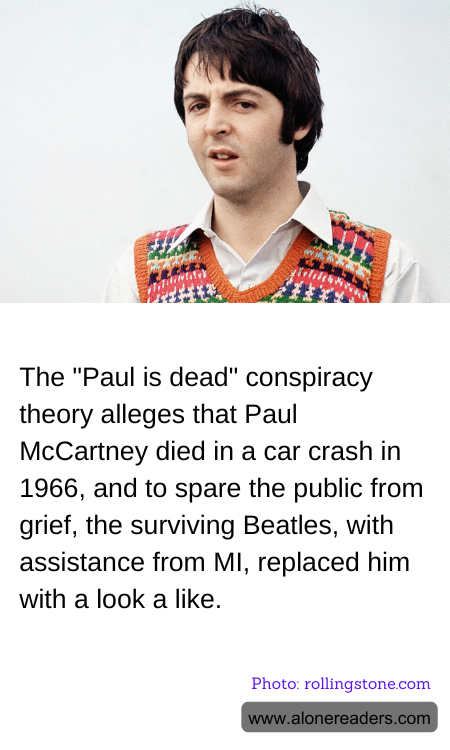
The "Paul is dead" conspiracy theory is one of the most enduring and intriguing tales in the annals of rock and roll folklore. It suggests that Paul McCartney, the beloved bassist of The Beatles, met an untimely demise in a car accident in 1966. According to the theory, the remaining members of the band, with the help of British intelligence agency MI5, orchestrated an elaborate cover-up to spare the world from the devastating news. They allegedly replaced McCartney with a look-alike, who continued to perform and record with the band, fooling fans and the public alike.
The origins of this conspiracy theory can be traced back to 1969, when a series of clues supposedly pointing to McCartney's death began to surface. Fans and conspiracy theorists alike scrutinized Beatles' album covers, song lyrics, and even audio recordings for hidden messages. One of the most famous pieces of "evidence" is the cover of the "Abbey Road" album, which some interpret as a funeral procession. In this interpretation, John Lennon, dressed in white, represents a clergyman; Ringo Starr, in black, is the undertaker; George Harrison, in denim, is the gravedigger; and McCartney, barefoot and out of step with the others, is the corpse.
Further fuel was added to the fire by the song "Revolution 9" from the "White Album," which, when played backward, allegedly reveals the phrase "turn me on, dead man." Similarly, the end of "Strawberry Fields Forever" is said to contain John Lennon murmuring "I buried Paul," though Lennon later clarified that he was actually saying "cranberry sauce." These supposed clues, along with others, have been dissected and debated for decades, keeping the conspiracy theory alive in popular culture.
Despite the compelling nature of these clues, the theory has been consistently debunked. Paul McCartney himself has addressed the rumors on multiple occasions, often with humor. In a 1969 interview with Life magazine, he quipped, "If I were dead, I’d be the last to know." The Beatles' official biographer, Hunter Davies, and other insiders have also dismissed the theory as pure fiction, attributing its persistence to the human penchant for mystery and intrigue.
The "Paul is dead" conspiracy theory serves as a fascinating case study in how myths can take root and flourish, even in the face of overwhelming evidence to the contrary. It highlights the power of suggestion and the allure of hidden meanings, especially when it comes to beloved cultural icons. While the theory remains a curious footnote in the history of The Beatles, it ultimately underscores the enduring legacy and influence of the band, whose music continues to captivate and inspire generations.