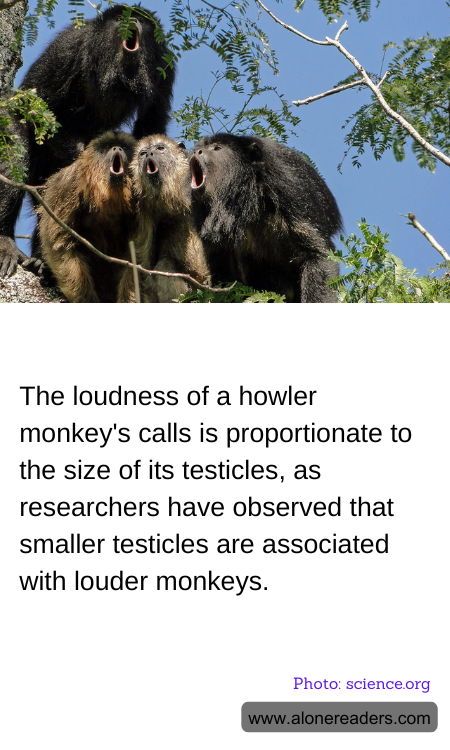
In the lush canopies of Central and South American forests, the howler monkey is renowned for its ear-piercing calls that can travel up to three miles through dense jungle. These vocalizations, often described as a haunting symphony of the wild, serve as a crucial communication tool for these primates. Recent research has uncovered a fascinating correlation between the loudness of these calls and the size of the monkey's testicles, offering new insights into the complex dynamics of animal behavior and evolution.
Howler monkeys are among the loudest land animals, and their calls play a significant role in territory defense and mate attraction. The study, conducted by a team of evolutionary biologists, suggests that the volume of a howler monkey's call is inversely related to the size of its testicles. In simpler terms, monkeys with smaller testicles tend to produce louder calls. This intriguing finding highlights a trade-off in the evolutionary strategies of these primates.
The relationship between vocalization and testicle size can be understood through the lens of sexual selection. In species where males compete for access to females, different strategies can evolve. For howler monkeys, it appears that some males invest in developing powerful vocal cords to assert dominance and deter rivals through sound, while others may invest more in reproductive capabilities, such as larger testicles, to increase their chances of successful mating when opportunities arise. This trade-off suggests that louder calls may compensate for smaller testicles by enhancing a male's ability to control a territory and attract females through auditory displays.
The study's findings also shed light on the broader implications of sexual selection and resource allocation in the animal kingdom. It underscores the idea that animals often face evolutionary pressures that force them to balance competing demands, such as attracting mates and ensuring reproductive success. In the case of howler monkeys, the choice between investing in vocal prowess or reproductive capacity illustrates the diverse strategies that can evolve within a species to maximize fitness.
This research not only enriches our understanding of howler monkeys but also contributes to the broader field of evolutionary biology. It emphasizes the importance of studying animal behavior in natural habitats to uncover the subtle and complex ways in which species adapt to their environments. As scientists continue to explore the intricacies of animal communication and reproduction, studies like this one remind us of the remarkable diversity of life on Earth and the myriad strategies that have evolved to ensure survival and reproduction in the wild.
In conclusion, the link between the loudness of a howler monkey's calls and the size of its testicles offers a captivating glimpse into the evolutionary strategies of these remarkable primates. By balancing the demands of vocalization and reproduction, howler monkeys exemplify the intricate dance of adaptation and survival in the natural world. As we continue to unravel the mysteries of animal behavior, such discoveries enrich our appreciation for the complexity and wonder of life in the wild.
