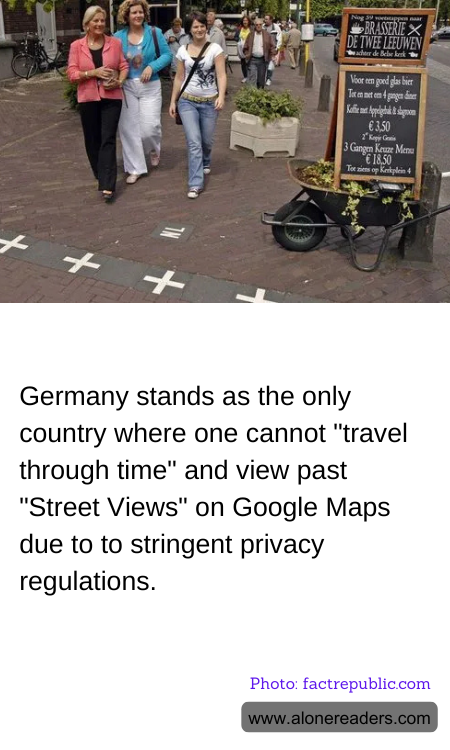
Germany is renowned for its robust privacy laws, which are among the strictest in the world. This commitment to privacy is evident in various aspects of life, including the digital realm. One notable manifestation of these stringent regulations is the unique situation regarding Google Maps' Street View feature. Unlike in other countries, where users can virtually travel through time and view past images captured by Google's cameras, Germany stands as the only nation where this capability is unavailable. This is due to the country's rigorous stance on protecting individual privacy.
The concept of "traveling through time" on Google Maps allows users to see how places have changed over the years by accessing historical images. This feature is available in many countries, offering a fascinating glimpse into the past and the evolution of urban landscapes. However, in Germany, the ability to view past Street Views is restricted. This decision stems from a broader cultural and legal emphasis on privacy, which has been shaped by the country's history and societal values.
Germany's privacy regulations are deeply rooted in its past, particularly the experiences of surveillance during the Nazi era and the East German Stasi regime. These historical contexts have fostered a strong public sentiment towards safeguarding personal privacy. Consequently, when Google first introduced Street View in Germany, it faced significant opposition. Many citizens and policymakers were concerned about the potential for privacy invasion, leading to a series of negotiations and compromises.
As a result, when Google launched Street View in Germany in 2010, it did so with several concessions. Residents were given the option to have their properties blurred, and many took advantage of this, resulting in a patchwork of obscured images across the country. Furthermore, the decision to restrict the historical view feature aligns with the broader regulatory framework that prioritizes individual privacy over technological convenience.
While some may view this as a limitation, others see it as a testament to Germany's commitment to protecting its citizens' rights. The absence of historical Street Views in Germany serves as a reminder of the delicate balance between technological advancement and privacy protection. It highlights the importance of considering ethical implications in the digital age, where the line between public interest and personal privacy can often blur.
In conclusion, Germany's unique position as the only country where one cannot "travel through time" on Google Maps' Street View is a reflection of its stringent privacy regulations. This approach underscores the nation's dedication to safeguarding personal privacy, even in the face of technological innovation. As digital landscapes continue to evolve, Germany's stance serves as a valuable example of prioritizing individual rights in an increasingly interconnected world.
