More About This Card
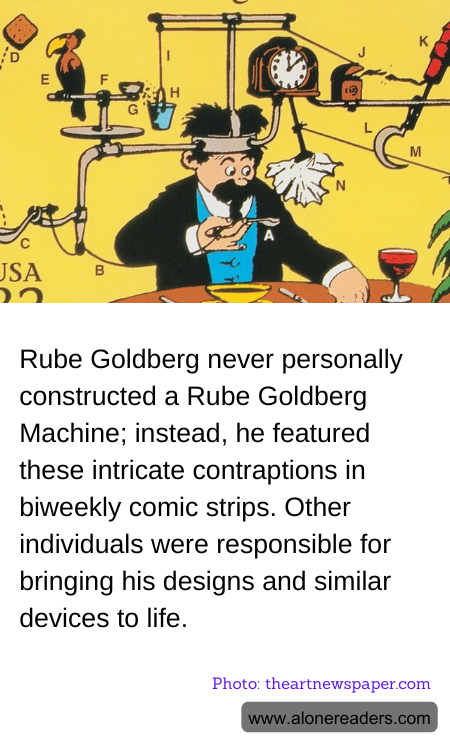
Rube Goldberg, a name synonymous with whimsical complexity, is often associated with the elaborate machines that bear his name. These contraptions, known as Rube Goldberg Machines, are characterized by their intricate and often humorous design, performing simple tasks in the most convoluted ways imaginable. However, what many might find surprising is that Rube Goldberg himself never actually constructed these machines. Instead, he brought them to life through his art, featuring them in biweekly comic strips that captivated audiences with their creativity and wit.
Born in 1883, Rube Goldberg was a man of many talents. He was an engineer, inventor, and most notably, a cartoonist. His background in engineering undoubtedly influenced his artistic endeavors, allowing him to envision machines that were as technically sound as they were absurdly complex. Goldberg's comic strips, which began gaining popularity in the early 20th century, depicted these fantastical devices in action. Each strip was a testament to his imagination, illustrating a series of chain reactions that culminated in the completion of a simple task, such as turning on a light or pouring a glass of water.
The charm of Goldberg's work lay in its ability to blend the mundane with the extraordinary. His machines were a satirical commentary on society's tendency to overcomplicate processes, a theme that resonated with audiences then and continues to do so today. Despite their complexity, the machines were never meant to be practical; they were a playful exploration of cause and effect, a celebration of creativity for creativity's sake. Goldberg's illustrations were rich in detail, each panel meticulously crafted to ensure that every cog, lever, and pulley played its part in the grand scheme.
While Rube Goldberg himself never physically constructed these machines, his influence inspired countless others to bring his designs to life. Enthusiasts and engineers alike have taken up the challenge, creating real-world versions of Goldberg's fantastical inventions. These modern-day interpretations can be found in science fairs, television shows, and even as part of educational curricula, where they serve as a fun and engaging way to teach principles of physics and engineering.
The legacy of Rube Goldberg Machines extends beyond mere entertainment. They encourage problem-solving, innovation, and a deeper understanding of mechanical processes. By attempting to recreate these machines, individuals are not only paying homage to Goldberg's genius but also engaging in a form of learning that is both hands-on and deeply rewarding. In this way, Rube Goldberg's work continues to inspire and educate, proving that even the most complex ideas can be accessible and enjoyable for people of all ages.
In essence, Rube Goldberg's contribution to the world was not in the physical construction of his machines but in the spark of imagination he ignited in others. His comic strips remain a testament to the power of creativity and the joy of thinking outside the box. Through his art, Goldberg has left an indelible mark on culture, reminding us that sometimes, the journey is just as important as the destination.