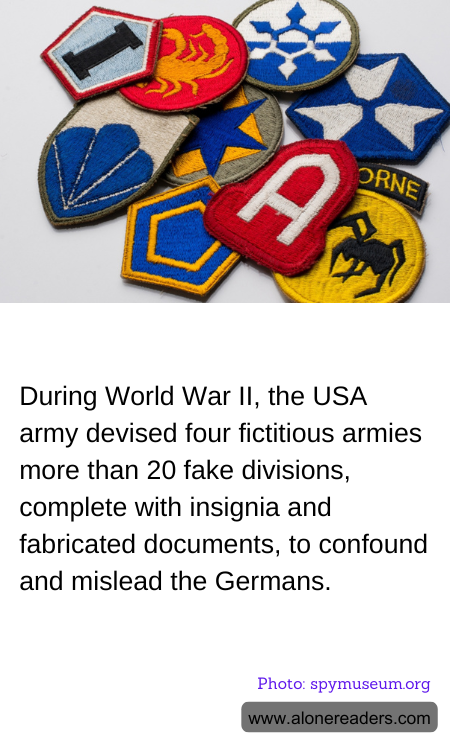
During World War II, the art of deception became a crucial weapon in the arsenal of the Allied forces. Among the most ingenious strategies employed was the creation of fictitious armies by the United States Army, a tactic designed to mislead and confuse the German military. This elaborate ruse involved the establishment of more than 20 fake divisions, complete with insignia, fabricated documents, and even dummy equipment, all orchestrated to create the illusion of formidable forces poised for battle.
The concept of these phantom armies was part of a broader strategy known as Operation Fortitude, which played a pivotal role in the success of the D-Day landings in Normandy. The Allies understood that misleading the Germans about the location and strength of their forces could provide a significant tactical advantage. By creating the illusion of large, well-equipped armies in various locations, the Allies aimed to disperse German defenses and keep them guessing about the true point of attack.
The execution of this plan required meticulous attention to detail. The fictitious divisions were given authentic-sounding names and were equipped with fake insignia to lend credibility to their existence. The deception extended to the creation of false radio traffic, which was carefully crafted to mimic the communications of real military units. This radio chatter was intercepted by the Germans, who were led to believe that these phantom divisions were preparing for operations in various strategic locations.
One of the most famous of these fictitious armies was the First United States Army Group (FUSAG), which was supposedly commanded by the charismatic General George S. Patton. The Germans held Patton in high regard, considering him one of the most formidable Allied commanders. By placing him at the helm of a non-existent army, the Allies were able to convince the Germans that the main invasion force would land at Pas de Calais, rather than Normandy. This misdirection was crucial in ensuring that German forces were not concentrated at the actual invasion site, thereby facilitating the success of the Normandy landings.
The success of these deceptive tactics was not solely due to the creation of fake divisions and armies. It was also supported by the efforts of the "Ghost Army," a specialized unit composed of artists, actors, and sound engineers. This unit was responsible for creating realistic visual and auditory illusions, including inflatable tanks, trucks, and artillery, as well as sound effects that mimicked the movements and operations of large military formations.
The use of fictitious armies during World War II stands as a testament to the power of deception in warfare. By employing creativity and cunning, the Allies were able to outmaneuver the Germans and achieve a strategic advantage that contributed significantly to the success of their military operations. This remarkable chapter in military history highlights the importance of innovation and adaptability in the face of adversity, lessons that continue to resonate in military strategy today.
