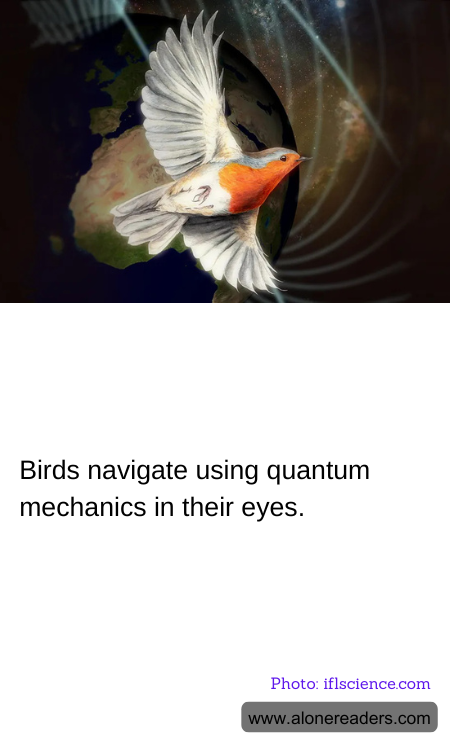
Birds have long fascinated scientists and nature enthusiasts alike with their incredible ability to navigate across vast distances. Recent research suggests that these feathered navigators might be employing a mechanism that sounds like it belongs in a science fiction novel: quantum mechanics. Specifically, it appears that certain birds use quantum processes in their eyes to detect the Earth's magnetic field, guiding them on their migratory journeys.
At the heart of this remarkable ability is a protein called cryptochrome, found in the retinas of birds. Cryptochrome is sensitive to blue light and is thought to play a crucial role in the birds' magnetic sense. When light hits this protein, it triggers a quantum reaction that creates a pair of radicals—molecules with unpaired electrons. These radicals are sensitive to magnetic fields, and their reactions can be influenced by the Earth's magnetic field, providing the bird with a kind of internal compass.
The process is believed to be a form of quantum entanglement, where the state of one particle is directly related to the state of another, no matter the distance between them. In the case of birds, the entangled particles are the electrons in the radical pairs. The Earth's magnetic field affects the spin states of these electrons, altering the chemical reactions within the cryptochrome. This, in turn, is thought to influence the bird's vision, allowing it to "see" the magnetic field as a pattern or a map overlaying its normal vision.
This quantum navigation system is not only a testament to the complexity of nature but also highlights the intersection of biology and physics in ways previously unimagined. The idea that birds might be using quantum mechanics to navigate has opened up new avenues of research, challenging scientists to rethink how animals interact with their environment. It also raises intriguing questions about the evolution of such sophisticated mechanisms and whether other animals might possess similar abilities.
Understanding how birds navigate using quantum mechanics could have broader implications beyond ornithology. It might inspire new technologies in navigation and sensor systems, leveraging the principles of quantum mechanics to develop tools that mimic this natural phenomenon. Moreover, it underscores the importance of preserving natural habitats, as disrupting the magnetic fields or light conditions could potentially interfere with these delicate quantum processes.
In conclusion, the notion that birds navigate using quantum mechanics in their eyes is a captivating example of the wonders of the natural world. It serves as a reminder of how much there is yet to learn about the intricate systems that govern life on Earth. As researchers continue to unravel these mysteries, we gain not only a deeper appreciation for the creatures that share our planet but also insights that could drive technological innovation and conservation efforts.
