More About This Card
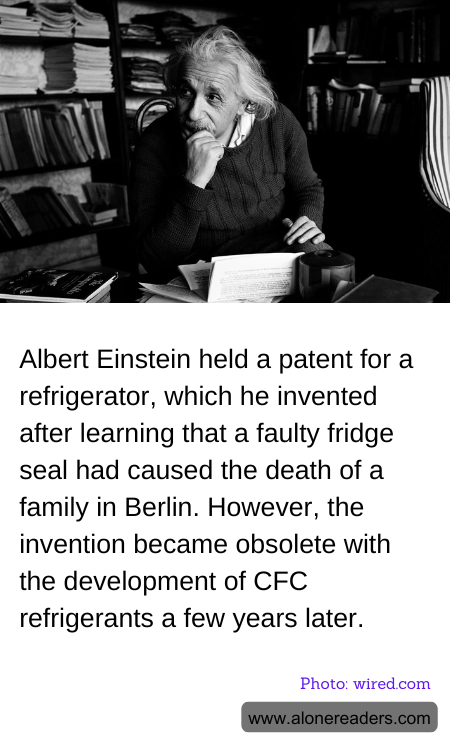
Albert Einstein, renowned for his groundbreaking contributions to theoretical physics, also ventured into the realm of practical inventions. Among his lesser-known achievements is a patent for a refrigerator, a device he co-invented with his former student, Leo Szilard, in the late 1920s. This invention was not merely a scientific curiosity but a response to a tragic incident that deeply affected Einstein.
The story begins with a tragic event in Berlin, where a family succumbed to toxic fumes due to a faulty refrigerator seal. At the time, refrigerators commonly used toxic gases like ammonia, methyl chloride, and sulfur dioxide as refrigerants. A leak in the system could lead to deadly consequences, as was the case with the unfortunate family. Einstein, moved by this tragedy, sought to create a safer alternative that would eliminate the risk of toxic gas leaks.
Einstein and Szilard's invention was a novel design that operated without moving parts, relying instead on a process known as absorption refrigeration. This design used a combination of water, ammonia, and butane to create a cooling effect. The absence of moving parts meant that there was no risk of mechanical failure, and the use of non-toxic substances made it a safer option for households. In 1930, they were granted a patent for their innovative refrigerator.
Despite its ingenuity, the Einstein-Szilard refrigerator faced challenges in gaining widespread adoption. Around the same time, the development of chlorofluorocarbon (CFC) refrigerants revolutionized the refrigeration industry. CFCs were non-toxic, non-flammable, and highly efficient, making them an attractive alternative to existing technologies. As a result, the Einstein-Szilard refrigerator quickly became obsolete, overshadowed by the rapid advancement of CFC-based systems.
While the refrigerator did not achieve commercial success, it remains a testament to Einstein's commitment to using science for the betterment of society. His foray into refrigeration highlights his willingness to tackle practical problems and his concern for public safety. Moreover, the story of the Einstein-Szilard refrigerator serves as a reminder of the importance of innovation in response to societal needs, even if the solutions do not always achieve immediate success.
In recent years, the environmental impact of CFCs has led to renewed interest in alternative refrigeration technologies. The Einstein-Szilard refrigerator, with its eco-friendly design, is once again being studied as a potential solution in the quest for sustainable refrigeration. This resurgence underscores the timeless nature of Einstein's work and his enduring legacy as a scientist who sought to improve the world in which he lived.