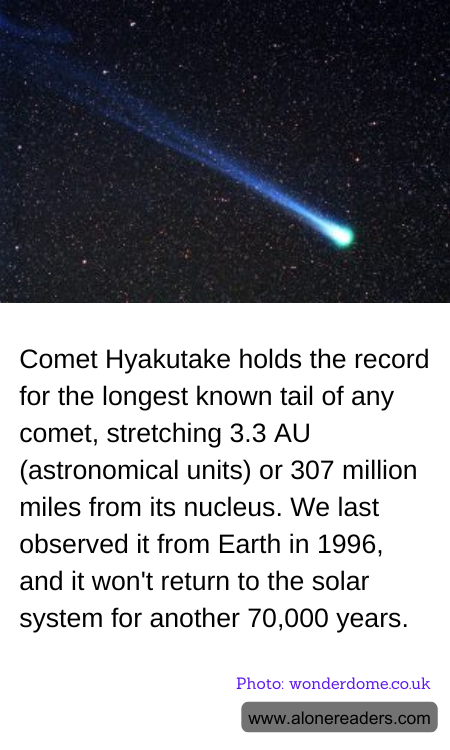
In the vast expanse of our solar system, comets are among the most fascinating celestial wanderers. One such remarkable visitor was Comet Hyakutake, which graced our skies in 1996. Known for its breathtaking appearance and extraordinary tail, Comet Hyakutake captivated astronomers and skywatchers alike, leaving an indelible mark in the annals of astronomical history.
Comet Hyakutake, officially designated as C/1996 B2, was discovered by Japanese amateur astronomer Yuji Hyakutake on January 30, 1996. This icy traveler quickly gained fame for its exceptionally long tail, which stretched an astounding 3.3 astronomical units (AU) from its nucleus. To put this into perspective, 3.3 AU is equivalent to approximately 307 million miles, making it the longest known tail of any comet observed to date. This immense tail was a result of the comet's volatile materials sublimating as it approached the Sun, creating a spectacular display that could be seen with the naked eye from Earth.
The appearance of Comet Hyakutake was a rare and awe-inspiring event. As it made its closest approach to Earth on March 25, 1996, at a distance of just 9.3 million miles, it became one of the brightest comets of the 20th century. Its proximity allowed observers to witness its vibrant blue-green coma and the magnificent tail that stretched across the night sky, providing a once-in-a-lifetime spectacle. The comet's visit was brief but memorable, as it quickly moved away from Earth and faded from view.
Despite its fleeting appearance, Comet Hyakutake left a lasting legacy in the field of astronomy. It provided scientists with valuable data about the composition and behavior of cometary bodies. The observations made during its passage helped enhance our understanding of the solar system's early history and the processes that govern cometary activity. The comet's long tail, in particular, offered insights into the interactions between solar wind and cometary material, contributing to our knowledge of space weather phenomena.
For those who witnessed Comet Hyakutake's celestial dance in 1996, it was an unforgettable experience. However, for those who missed it, the wait for its return will be a long one. Comet Hyakutake is not expected to return to the inner solar system for another 70,000 years. Until then, it remains a testament to the wonders of the universe and the enduring allure of comets. As we continue to explore the cosmos, Comet Hyakutake serves as a reminder of the beauty and mystery that lies beyond our planet, inspiring future generations to look up and marvel at the night sky.
