More About This Card
The Berlin Airlift, a monumental humanitarian effort from 1948 to 1949, stands as a testament to human resilience and cooperation in the face of adversity. In the aftermath of World War II, Germany was divided into four occupation zones controlled by the United States, the United Kingdom, France, and the Soviet Union. Berlin, located deep within the Soviet-controlled zone, was similarly divided. Tensions between the Soviet Union and the Western Allies escalated, culminating in the Soviet blockade of all ground routes to West Berlin in June 1948. This blockade aimed to force the Western Allies out of the city by cutting off all supplies, leaving over two million residents without access to food, fuel, and other essential goods.
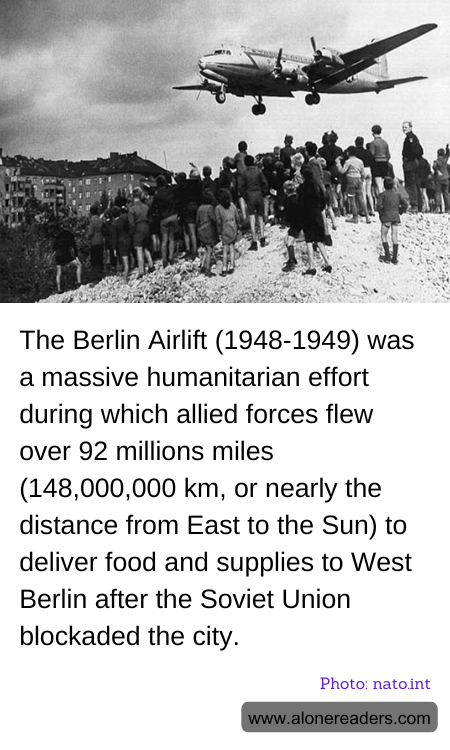
In response to this dire situation, the Western Allies launched the Berlin Airlift, an unprecedented operation to supply the beleaguered city by air. Over the course of 15 months, American, British, and other allied forces flew over 92 million miles, delivering vital supplies to sustain the population of West Berlin. This distance is nearly equivalent to traveling from the Earth to the Sun, underscoring the immense scale and dedication involved in the operation. The airlift required meticulous planning and coordination, with planes landing at Tempelhof, Gatow, and Tegel airports every few minutes, around the clock.
The success of the Berlin Airlift was not only a logistical triumph but also a powerful symbol of solidarity and determination. Pilots and crews worked tirelessly, often under challenging conditions, to ensure the continuous flow of supplies. The operation delivered over 2.3 million tons of goods, including food, coal, and medical supplies, effectively thwarting the Soviet blockade. The airlift demonstrated the resolve of the Western Allies to support the people of West Berlin and maintain their presence in the city, despite Soviet pressure.
The Berlin Airlift also had significant political and social implications. It marked a turning point in the Cold War, solidifying the division between East and West and reinforcing the commitment of the United States and its allies to defend democratic values. The operation fostered a sense of unity and cooperation among the Western nations, laying the groundwork for future alliances such as NATO. For the people of West Berlin, the airlift was a lifeline, providing not only physical sustenance but also hope and reassurance that they were not alone in their struggle.
In May 1949, the Soviet Union lifted the blockade, acknowledging the futility of their efforts to isolate West Berlin. The Berlin Airlift remains a remarkable example of human ingenuity and perseverance, illustrating how nations can come together to overcome seemingly insurmountable challenges. It serves as a reminder of the power of collaboration and the enduring spirit of humanity in the face of adversity.