More About This Card
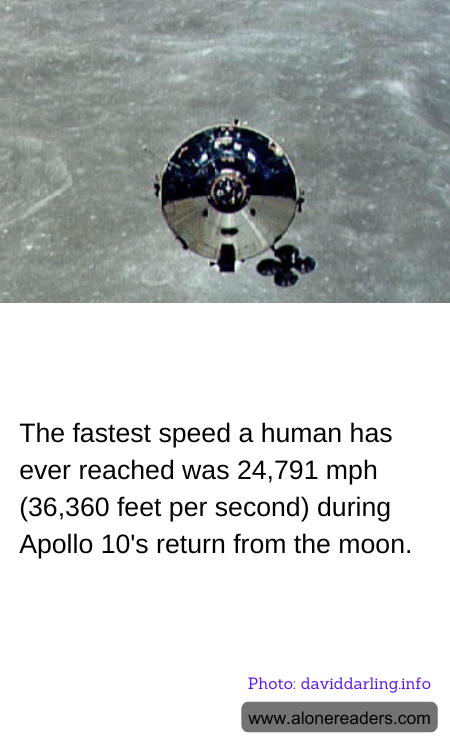
In the annals of human achievement, the Apollo 10 mission stands out not only for its critical role in paving the way for the first moon landing but also for setting a remarkable record in human space travel. During its return journey from the moon in May 1969, the Apollo 10 spacecraft reached an astonishing speed of 24,791 miles per hour, equivalent to 36,360 feet per second. This remains the fastest speed ever achieved by a human being, a testament to the ingenuity and daring of the space pioneers of the 20th century.
Apollo 10 was the fourth crewed mission in the Apollo program and served as a "dress rehearsal" for the historic Apollo 11 moon landing. The mission's primary objective was to test all the components and procedures of a lunar landing without actually touching down on the moon's surface. Commanded by Thomas Stafford, with John Young as the command module pilot and Eugene Cernan as the lunar module pilot, the mission provided critical data and experience that would ensure the success of Apollo 11.
The record-breaking speed was achieved during the spacecraft's re-entry into Earth's atmosphere. As Apollo 10 hurtled back from the moon, it was pulled by Earth's gravity, accelerating to incredible velocities. This speed was necessary to ensure the spacecraft could safely penetrate the atmosphere and splash down in the Pacific Ocean. The re-entry phase is one of the most challenging aspects of space travel, requiring precise calculations to balance speed and trajectory to avoid burning up or bouncing off the atmosphere.
The achievement of reaching such a high speed is not just a technical marvel but also a reflection of the human spirit's relentless pursuit of exploration and discovery. The Apollo program, with its series of missions, showcased the potential of human ingenuity and the ability to overcome seemingly insurmountable challenges. The speed record set by Apollo 10 remains unbeaten, highlighting the unique conditions and requirements of lunar missions compared to other forms of space travel.
For many, the Apollo missions symbolize a golden era of space exploration, where the boundaries of what was possible were continually pushed. The legacy of Apollo 10's speed record is a reminder of the extraordinary feats that can be accomplished when vision, courage, and technology converge. As we look to the future of space exploration, with renewed interest in returning to the moon and venturing to Mars, the achievements of the past serve as both inspiration and a benchmark for what humanity can achieve when it dares to dream big.