More About This Card
During the tumultuous years of World War II, diplomatic exchanges often carried significant weight, reflecting the complex relationships between nations. One such exchange occurred between Adolf Hitler and King Christian X of Denmark, highlighting the tension and subtle defiance that characterized Denmark's relationship with Nazi Germany.
In the early 1940s, Denmark found itself under German occupation, a situation that placed King Christian X in a delicate position. Despite the occupation, the king remained a symbol of national unity and resilience for the Danish people. His interactions with the German regime were closely watched, both at home and abroad.
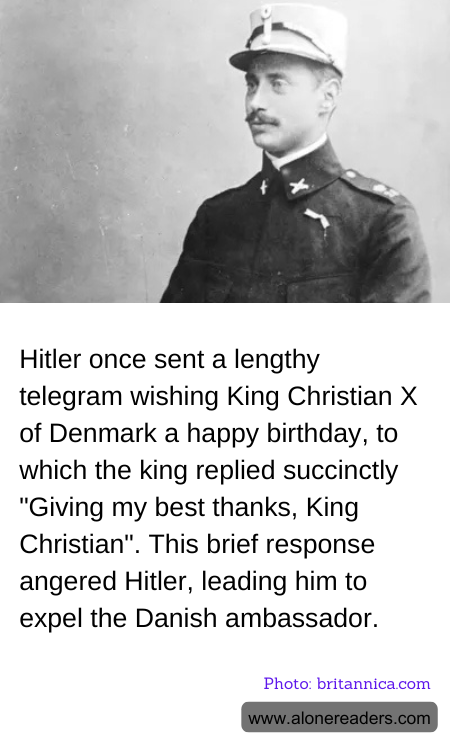
On the occasion of King Christian X's birthday, Adolf Hitler sent a lengthy and formal telegram extending his best wishes. This gesture, while seemingly cordial, was laden with political undertones. It was an attempt by Hitler to maintain a veneer of diplomatic politeness and perhaps to assert a sense of dominance over the occupied nation. The expectation was likely that the king would respond in kind, acknowledging the gesture with a similarly elaborate reply.
However, King Christian X's response was anything but elaborate. In a move that would become legendary, he replied with a terse and pointed message: "Giving my best thanks, King Christian." This brief response was not only a departure from diplomatic norms but also a subtle act of defiance. It conveyed a sense of dignity and restraint, refusing to engage in the expected exchange of pleasantries with the occupying power.
Hitler's reaction to this succinct reply was one of anger. The brevity of the king's message was perceived as an affront, a slight that could not be overlooked. In retaliation, Hitler took the drastic step of expelling the Danish ambassador from Germany. This action underscored the sensitivity of diplomatic communications during the war and highlighted the precarious nature of Denmark's position under occupation.
The incident became emblematic of King Christian X's quiet resistance to Nazi rule. His ability to maintain a sense of national pride and integrity, even in the face of overwhelming pressure, resonated deeply with the Danish people. The king's understated defiance served as a reminder that even small acts of resistance could carry significant symbolic weight.
In the broader context of World War II, this exchange between Hitler and King Christian X illustrates the power of diplomacy and the impact of seemingly minor interactions. It serves as a testament to the resilience of a nation and its leader, who, through a simple yet powerful message, managed to assert their dignity in the face of adversity.