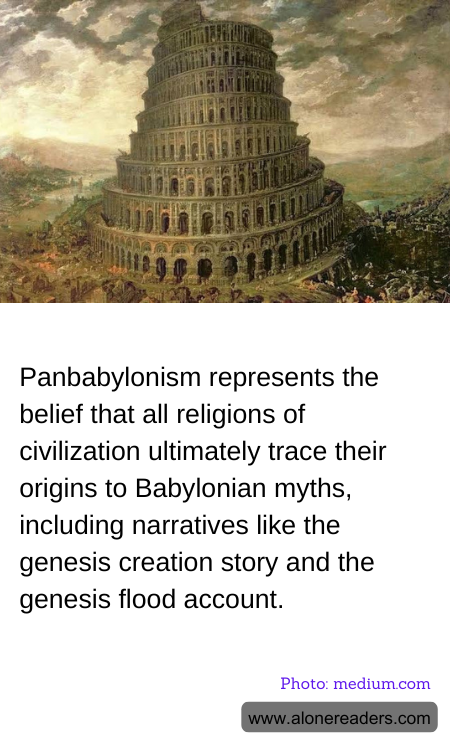
Panbabylonism is a fascinating theory that suggests a significant portion of the world's religious narratives can be traced back to ancient Babylonian myths. This idea, which gained prominence in the late 19th and early 20th centuries, posits that the mythological and religious traditions of various civilizations have their roots in the rich tapestry of Babylonian mythology. Central to this theory is the belief that stories such as the Genesis creation narrative and the Genesis flood account in the Bible are heavily influenced by earlier Babylonian myths.
The proponents of Panbabylonism argue that the cultural and religious influence of Babylon was so profound that it permeated the religious texts and traditions of neighboring civilizations. This influence is particularly evident in the similarities between the Babylonian creation myth, the Enuma Elish, and the Genesis creation story. In the Enuma Elish, the world is created from the chaotic waters, a theme that resonates with the biblical account of creation, where the earth is formed from a formless void. Similarly, the Babylonian flood myth, as recounted in the Epic of Gilgamesh, shares striking parallels with the Genesis flood story, including the divine decision to flood the earth and the survival of a chosen individual who builds a boat to save himself, his family, and various animals.
While Panbabylonism provides an intriguing lens through which to view the interconnectedness of ancient cultures, it is not without its critics. Some scholars argue that the theory overemphasizes the influence of Babylonian myths and underestimates the originality and diversity of other ancient cultures. They contend that while there are undeniable similarities, these could be attributed to shared human experiences and the natural development of similar themes across different societies rather than direct borrowing from Babylonian sources.
Despite the debates surrounding Panbabylonism, the theory has undeniably contributed to a deeper understanding of the cultural exchanges that shaped the ancient world. It highlights the importance of Babylon as a cultural and religious hub, whose myths and stories resonated far beyond its borders. This perspective encourages a broader appreciation of how ancient civilizations interacted and influenced one another, leading to the rich tapestry of religious narratives that we see today.
In conclusion, Panbabylonism offers a compelling narrative about the origins and dissemination of religious myths. Whether one fully subscribes to the theory or views it with skepticism, it undeniably underscores the interconnectedness of human cultures and the shared heritage of storytelling that transcends time and geography. As we continue to explore the depths of ancient mythology, Panbabylonism serves as a reminder of the enduring legacy of Babylonian myths and their potential impact on the religious traditions that followed.
