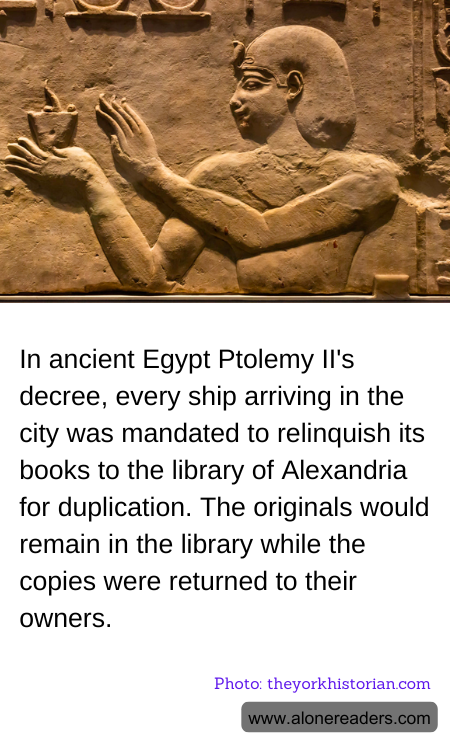
In the annals of history, the Library of Alexandria stands as a beacon of knowledge and intellectual pursuit. Among the many fascinating aspects of this ancient institution was a decree by Ptolemy II Philadelphus, a ruler of the Ptolemaic dynasty in Egypt, which underscored the library's commitment to amassing a comprehensive collection of the world's knowledge. This decree mandated that every ship docking in the bustling port city of Alexandria was required to surrender its books to the library for duplication. This initiative not only expanded the library's collection but also highlighted the importance placed on knowledge and learning in ancient Egyptian society.
The process was straightforward yet ingenious. Upon arrival, the books from the ships were taken to the library where skilled scribes meticulously copied each text. The originals were retained by the library, while the copies were returned to the ship owners. This practice ensured that the library's collection grew exponentially, encompassing works from various cultures and disciplines. The library's holdings included texts on philosophy, science, mathematics, and literature, making it a melting pot of knowledge from across the ancient world.
Ptolemy II's decree was not merely an act of acquisition but a reflection of the era's reverence for learning and scholarship. By retaining the original texts, the Library of Alexandria positioned itself as a custodian of authentic knowledge. This practice also underscored the belief that knowledge should be preserved and shared, a principle that resonates with modern values of open access to information.
The impact of this decree was profound. The Library of Alexandria became a hub for scholars and intellectuals, attracting luminaries from various fields who were drawn to its vast resources. It fostered an environment of intellectual exchange and innovation, contributing significantly to advancements in science, philosophy, and the arts. The library's reputation as a center of learning was unparalleled, and its influence extended far beyond the borders of Egypt.
While the library itself was eventually lost to history, the legacy of Ptolemy II's decree endures. It serves as a testament to the enduring human quest for knowledge and the lengths to which societies will go to preserve and disseminate information. The story of the Library of Alexandria and its unique approach to collecting books continues to inspire modern libraries and institutions dedicated to the preservation of knowledge.
In a world where information is more accessible than ever, the principles embodied by the Library of Alexandria remain relevant. The idea that knowledge should be shared and preserved for future generations is a cornerstone of educational and cultural institutions today. Ptolemy II's decree, with its emphasis on the acquisition and dissemination of knowledge, reminds us of the timeless value of learning and the enduring power of books to connect us with the past and illuminate the future.
