More About This Card
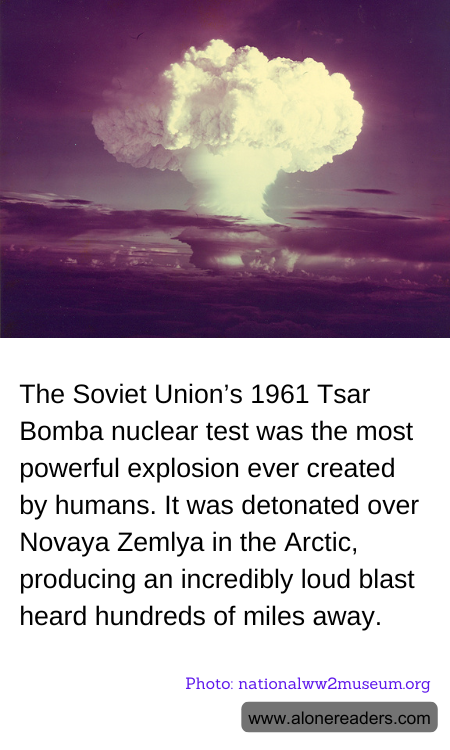
In the annals of human history, few events have demonstrated the sheer power of scientific advancement and the potential for destruction as vividly as the detonation of the Tsar Bomba. Conducted by the Soviet Union on October 30, 1961, this nuclear test remains the most powerful explosion ever created by humans. The test took place over the remote archipelago of Novaya Zemlya in the Arctic, a location chosen for its isolation and vast expanses of uninhabited land.
The Tsar Bomba, officially designated as AN602, was a hydrogen bomb with a yield of 50 megatons, equivalent to 50 million tons of TNT. This staggering power was more than 3,000 times the strength of the bomb dropped on Hiroshima during World War II. The explosion was so immense that it produced a mushroom cloud that soared over 60 kilometers into the atmosphere, visible from a distance of over 1,000 kilometers. The blast wave circled the Earth three times, and the seismic shock was detectable even on its third pass.
The detonation of the Tsar Bomba was not just a demonstration of military might but also a statement of technological prowess during the height of the Cold War. The Soviet Union sought to showcase its capabilities to both its adversaries and allies, asserting its position as a formidable superpower. The test was meticulously planned, with the bomb being dropped from a specially modified Tu-95 bomber, which had to be reinforced to withstand the blast's shockwave. Despite the precautions, the aircraft barely escaped the explosion's reach.
The impact of the Tsar Bomba was profound, both physically and politically. The explosion's light was so intense that it could be seen from as far away as Norway and Greenland, and the sound of the blast was heard hundreds of miles from the detonation site. The environmental consequences were significant, with the blast vaporizing the ground beneath it and causing extensive radioactive fallout. However, due to the remote location, the immediate human impact was minimal, though it served as a stark reminder of the potential consequences of nuclear warfare.
In the years following the test, the Tsar Bomba became a symbol of the nuclear arms race, highlighting the destructive potential of nuclear weapons and the urgent need for disarmament. It spurred international dialogue on nuclear testing and contributed to the eventual signing of treaties aimed at limiting the proliferation of nuclear weapons. Today, the legacy of the Tsar Bomba serves as a powerful reminder of the responsibilities that come with technological advancement and the importance of pursuing peace and stability in a world capable of such immense destruction.