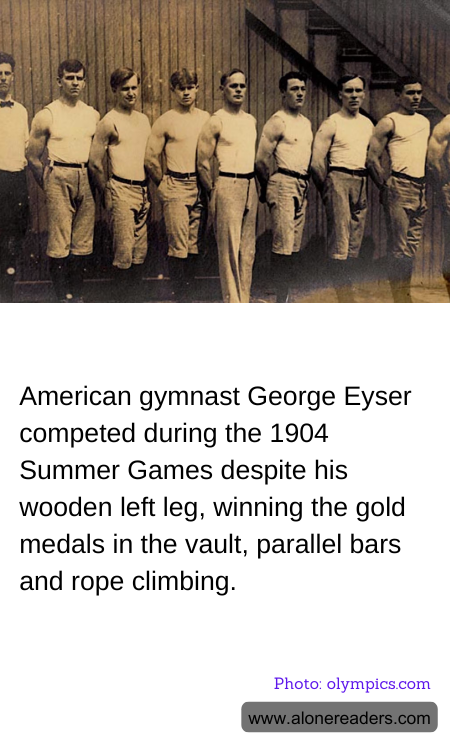
In the annals of Olympic history, few stories are as inspiring as that of George Eyser, an American gymnast who defied the odds to achieve greatness. Competing in the 1904 Summer Games held in St. Louis, Missouri, Eyser's remarkable performance is a testament to human resilience and determination. What makes his achievements even more extraordinary is that he accomplished them with a wooden left leg.
Born in Germany in 1870, George Eyser immigrated to the United States with his family, where he eventually became a naturalized citizen. Despite losing his left leg in a train accident, Eyser's passion for gymnastics never waned. He trained rigorously, adapting his techniques to accommodate his prosthetic limb. His dedication and perseverance paid off when he qualified to compete in the 1904 Olympics, representing the Concordia Turnverein of St. Louis.
The 1904 Summer Games were unique in many ways, being the first Olympics held in the United States and featuring a diverse array of events. For Eyser, it was an opportunity to showcase his skills on a global stage. Competing against able-bodied athletes, he demonstrated exceptional prowess in multiple disciplines. Eyser's most notable achievements came in the vault, parallel bars, and rope climbing events, where he clinched gold medals. His victory in the vault was particularly impressive, as it required explosive power and precision, qualities Eyser had honed despite his physical limitations.
In addition to his gold medals, Eyser also earned silver medals in the pommel horse and the combined four events, as well as a bronze in the horizontal bar. His success at the 1904 Olympics was not only a personal triumph but also a significant moment in the history of adaptive sports. Eyser's accomplishments challenged perceptions of disability and demonstrated that physical limitations do not define an athlete's potential.
George Eyser's legacy continues to inspire athletes around the world. His story is a powerful reminder that determination and hard work can overcome even the most daunting obstacles. In a time when prosthetic technology was rudimentary at best, Eyser's ability to compete at the highest level is a testament to his extraordinary spirit and dedication to his sport.
Today, Eyser's achievements are celebrated as a pioneering moment in the Paralympic movement, highlighting the importance of inclusivity and accessibility in sports. His life and career serve as an enduring example of how the human spirit can triumph over adversity, inspiring generations to pursue their dreams regardless of the challenges they face.
