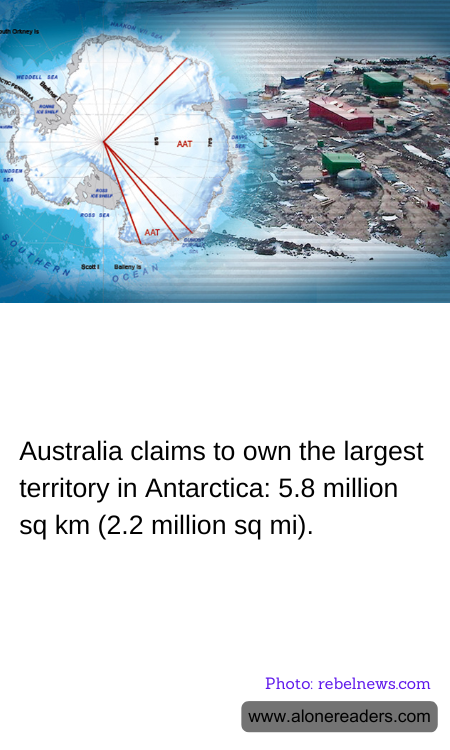
Australia's claim to the largest territory in Antarctica, spanning an impressive 5.8 million square kilometers (2.2 million square miles), is a fascinating aspect of international geopolitics and environmental stewardship. This vast expanse, known as the Australian Antarctic Territory (AAT), represents about 42% of the continent, making it the largest territorial claim by any nation on the icy continent. The claim, however, is subject to the complex and unique legal framework established by the Antarctic Treaty System, which governs international relations concerning Antarctica.
The origins of Australia's claim date back to the early 20th century, when British explorers first charted parts of the Antarctic coastline. In 1933, the United Kingdom formally transferred its claim to Australia, a move that was later solidified by the Antarctic Treaty of 1959. This treaty, signed by 12 countries, including Australia, effectively froze all territorial claims and established Antarctica as a zone dedicated to peace and scientific research. While the treaty does not recognize or dispute existing claims, it prohibits new claims and military activity, ensuring that the continent remains a natural reserve devoted to science.
Australia's stewardship of its Antarctic territory is driven by a commitment to scientific research and environmental conservation. The Australian Antarctic Division, a branch of the Department of Climate Change, Energy, the Environment and Water, manages the country's activities on the continent. This includes operating research stations such as Casey, Davis, and Mawson, which serve as hubs for scientific exploration in fields ranging from glaciology and marine biology to climate science and astronomy. These efforts contribute significantly to the global understanding of climate change, as Antarctica plays a crucial role in the Earth's climate system.
The AAT is not just a scientific frontier but also a symbol of Australia's dedication to international cooperation and environmental protection. The Antarctic Treaty System encourages collaboration among nations, allowing scientists from around the world to work together in pursuit of knowledge and the preservation of this pristine environment. Australia's active participation in this system underscores its commitment to maintaining Antarctica as a place of peace and scientific inquiry.
Despite the peaceful intentions of the Antarctic Treaty, the future of territorial claims in Antarctica remains uncertain. As global interest in the continent's resources grows, particularly in terms of mineral and biological wealth, the potential for geopolitical tensions could increase. However, Australia's leadership in promoting sustainable and cooperative management of the Antarctic region sets a positive example for other nations.
In conclusion, Australia's claim to the largest territory in Antarctica highlights the country's significant role in the stewardship of this unique and fragile environment. Through its commitment to scientific research and international collaboration, Australia continues to contribute to the preservation of Antarctica as a global commons dedicated to peace and knowledge. As the world faces the challenges of climate change and resource management, the principles established by the Antarctic Treaty System remain more relevant than ever, ensuring that Antarctica remains a place of wonder and discovery for future generations.
