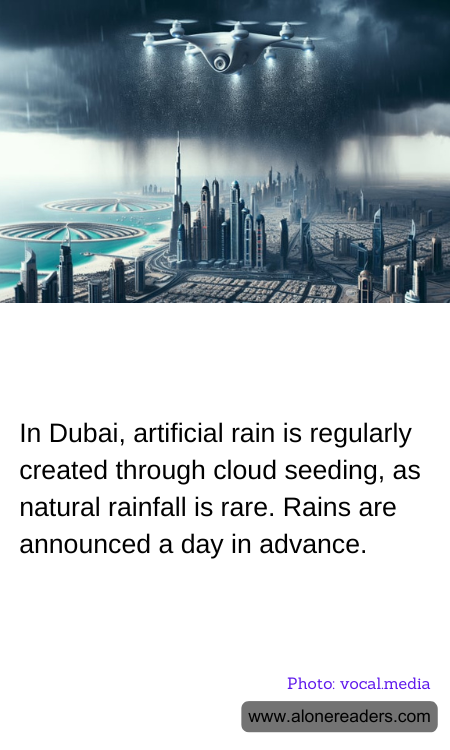
Dubai, a city renowned for its futuristic skyline and luxurious lifestyle, is also at the forefront of innovative weather modification techniques. In a region where natural rainfall is a rarity, Dubai has turned to cloud seeding to artificially induce rain, a practice that has become a regular part of its weather management strategy. This technological intervention not only addresses water scarcity but also showcases Dubai's commitment to leveraging advanced science to tackle environmental challenges.
Cloud seeding in Dubai involves dispersing substances into the atmosphere to encourage cloud condensation, thereby increasing the likelihood of precipitation. This process typically uses planes to release salt crystals or other chemicals into clouds, which then attract moisture and lead to rainfall. The technique has been refined over the years, making it a reliable method for enhancing rainfall in arid regions. In Dubai, where the average annual rainfall is a mere 100 millimeters, cloud seeding has become a crucial tool in ensuring water availability for both domestic and agricultural needs.
One of the remarkable aspects of Dubai's cloud seeding program is the predictability it offers. Unlike natural rain, which can be sporadic and unpredictable, artificial rain can be scheduled and announced a day in advance. This allows residents and businesses to plan accordingly, minimizing disruptions and maximizing the benefits of the rainfall. The ability to forecast rain with such precision is a testament to the sophisticated technology and expertise employed in the process.
The implementation of cloud seeding in Dubai is not without its critics, however. Some environmentalists express concerns about the long-term ecological impacts of altering weather patterns and the potential chemical residues left in the environment. Despite these concerns, the government maintains that the benefits, particularly in terms of water security, outweigh the potential risks. Continuous research and monitoring are conducted to ensure that the practice remains safe and effective.
Dubai's use of cloud seeding is a reflection of its broader vision to harness technology for sustainable development. As climate change continues to pose challenges globally, the city's proactive approach to managing its water resources serves as a model for other regions facing similar issues. By investing in innovative solutions like cloud seeding, Dubai not only addresses its immediate needs but also contributes to the global discourse on sustainable environmental practices.
In conclusion, the regular creation of artificial rain through cloud seeding in Dubai is a fascinating example of how technology can be used to overcome natural limitations. By announcing rains a day in advance, the city not only ensures efficient water management but also demonstrates its commitment to pioneering solutions in the face of environmental challenges. As the world grapples with the effects of climate change, Dubai's experience offers valuable insights into the potential of technological interventions in weather modification.
